
Beautiful Hotels in Paris
Paris does not build hotels so much as convert what it already has. Five of these were something else first: a palace Louis XV commissioned for the square that became the Place de la Concorde, the residence of Napoleon's great-nephew, who spent his life on geography and botany, the townhouse built for the Duc de Morny's family on avenue Gabriel under the Second Empire, two early eighteenth-century mansions on the Place Vendome, and the Seine-facing corner of a department store that had stood shut since 2005. The restorations ran under heritage protection that fixes the facades and the listed rooms, so most of the money went where you cannot see it, and the same architect, Richard Martinet, turns up on four of them. The kitchens are the other measure: three Michelin stars at Epicure, three at Le Gabriel, three at Plenitude, six across three rooms at the George V, two at Le Meurice and one at Espadon. These are the eleven stays worth planning the trip around.
Map
Four Seasons Hotel George V, Paris
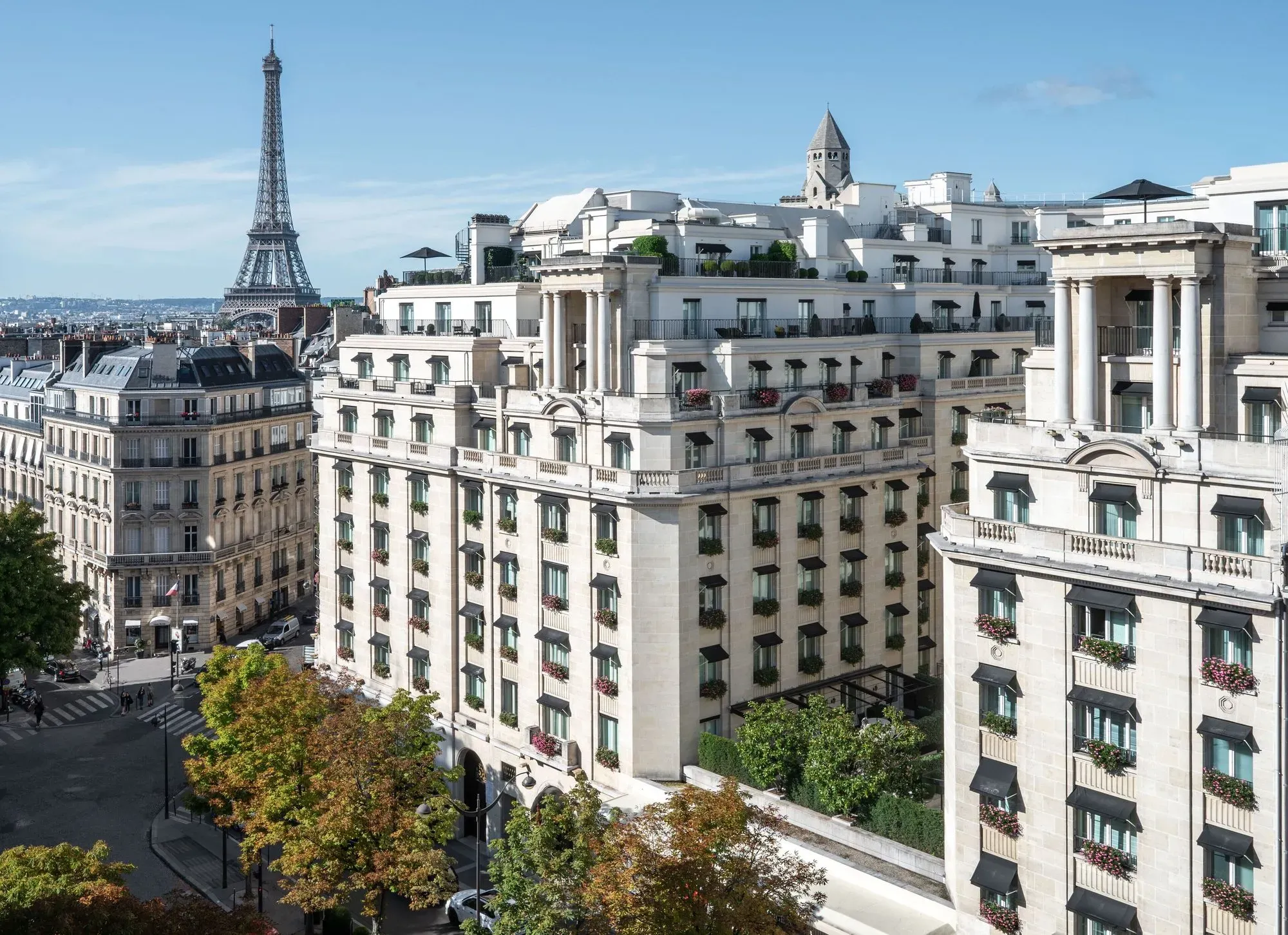
Three trucks pull onto Avenue George V every week with flowers from Amsterdam growers, some of whom grow for this address alone. Jeff Leatham has been arranging them since 1999, and the themes, the colours and the vase placements change every three weeks. Lefranc and Wybo drew the building around a sunlit inner courtyard, and it opened in 1928 with two bathrooms to a suite at a time when a single en-suite bath was rare in Paris. François Dupré bought the place in 1931, and a wing followed, its apartments let by the year or the season, their residents served by the hotel. Fourteen metres below ground the cellar occupies former stone quarries and keeps some fifty thousand bottles. Pierre-Yves Rochon, who did the interiors for the 1999 reopening, took three years to rework all 243 rooms and suites and finished in 2025, with the hotel open throughout. He laid them out as apartments rather than hotel floors, so vestibules stand where corridors were, the dressing rooms are modelled on couture ateliers, and there are libraries and rooms to eat in, with new French windows drawing the light deeper. The smallest category on the plan starts at 37 square metres. Balconies have been planted out into small gardens, and in the Parisian Eiffel Suite the bathroom runs to white Carrara marble with Baccarat crystal taps. The Penthouse holds the top floor, three terraces to itself, and the Eiffel Tower in front of it. A garden of white orchids meets the eye first.
Booking through this link earns us a commission. It costs you nothing extra, and no hotel has paid to be selected.
Hôtel de Crillon, A Rosewood Hotel
The bathtub in Les Grands Appartements was cut from a single slab of Carrara marble, and at over two tonnes it came in through a fourth-floor window on a crane, lowered onto two blocks of ice that melted slowly enough to set it down without damaging the floor. Louis XV had Ange-Jacques Gabriel raise two identical facades either side of the rue Royale in 1758. The ground behind the western one was cut into four lots and sold to private buyers who had to build behind Gabriel's front. Louis-François Trouard bought the westernmost in 1775 and drew the house himself. François Félix de Crillon bought it as a family home in 1788, and it opened as a hotel in March 1909. The colonnade and the sculpted front are classified, the higher of the two French heritage grades. Rosewood reopened it on 5 July 2017 after four years of work. Richard Martinet ran the architecture under heritage protection covering the facade and the second-floor reception rooms, while Aline Asmar d'Amman took artistic direction. The job ran to 250 artisans across 147 separate crafts, 53 varieties of marble, and 17,000 cubic metres excavated from under the building. There are 78 rooms, 36 suites and ten signature suites. Karl Lagerfeld decorated the two on the fourth floor facing the Concorde, and Chahan Minassian put the three Ateliers d'Artistes under the mansard roof in what were once the administrative offices. Upstairs the listed salons keep ceilings from 1775 and 1776 that clear six metres. The Salon des Aigles is where the Covenant of the League of Nations was drafted through the winter of 1919, though the signing itself happened at Versailles that June.
Booking through this link earns us a commission. It costs you nothing extra, and no hotel has paid to be selected.
Le Bristol Paris
Socrate arrived in 2021 to a letter of welcome from Emmanuel Macron, and he has had the run of the lobby ever since. He is the latest of the hotel's cats, and he keeps his own hours. Hippolyte Jammet bought the old Castellane property in 1924 and had it pulled down, handing the site to Gustave Umbdenstock and Urbain Cassan, who raised an Art Deco palace. It opened in April 1925, named for Frederick Augustus Hervey, fourth Earl of Bristol, an eighteenth-century bishop whose travels set the standard for comfort. Rudolf August Oetker bought it in 1978 and it has stayed in his family. No two of the 188 rooms repeat, which is less flourish than consequence: locksmiths, carpenters, marble workers and decorative painters keep workshops on the premises and make whatever the house needs. For the centenary in 2025, Elvira and Narcisa Oetker reworked the Suite Impériale with the architect Pierre-Yves Rochon and the painter George Condo, whose pictures now hang across its 320 square metres, with a connecting bedroom left as his studio, easel and paints still in it. The doorknob he designed for it is a gilded clown's head titled Uncle Joe. Arabella Lennox-Boyd redrew the garden in 2017, pleached hornbeam and black slate rills under treillage, all of it on roof slabs above an underground garage with almost no soil to plant into. The spa's eight treatment rooms open onto it. Cäsar Pinnau, who drew the yachts of Onassis and Niarchos, built the pool six floors up and worked the room into a ship, a wooden deck around the water, a painted sail over the ceiling and a mural of passengers at the stern looking toward Cap d'Antibes. The Eiffel Tower stands in the far window.
Booking through this link earns us a commission. It costs you nothing extra, and no hotel has paid to be selected.
Cheval Blanc Paris
The bow windows along the quai du Louvre were kept rather than replaced, and behind the glass sit the winter gardens of the Seine junior suites, each one turned to the water. The building runs along the riverbank between the Louvre and the Pont Neuf. Henri Sauvage finished this river front in 1928, plain cream stone with the top floors stepping back, by which time the art nouveau of the older store had fallen out of fashion. The shop closed for safety in 2005 and stayed shut sixteen years while LVMH rebuilt the block around it, Édouard François running the conversion of the Sauvage building into a hotel and handing it over in 2019. Cheval Blanc opened in September 2021, and Atout France added it to the list of French palaces in June 2026. All 72 rooms and suites take the building's art deco as a starting point and finish contemporary, with marble bathrooms, a bathtub and a walk-in hammam shower in each, and a dressing room kept separate from the bedroom. The two scents in the rooms, Parisian Chic Boisé and Parisian Chic Poudré, were made for the house by François Demachy, formerly the perfumer at Maison Dior. Peter Marino did the interiors throughout. At the top, the Quintessence Suite spreads over the eighth and ninth floors as a tribute to Claude and François-Xavier Lalanne, and joins the Ravel Suite to make a thousand square metre apartment with seven bedrooms, a private lift and its own parking space. The Dior Spa Cheval Blanc runs a thirty metre pool, and Le Carrousel, the children's club, is free. A majordome is on call.
The Peninsula Paris
Every room has a valet box. Shoes go out for shining, laundry goes out and comes back, the morning paper comes in, and the only door anyone has to open is that one. The ground at 19 avenue Kléber held a private palace long before it held a hotel, raised in 1864 by a Russian collector who wanted a Versailles of his own, then home to Isabella II of Spain, who lived out her exile there and died in the house in 1904. It came down soon after. Leonard Tauber put a grand hotel on the site and Armand Sibien's Majestic opened in 1908. The French state bought the building in 1936, and UNESCO's preparatory commission moved in from London on 16 September 1946, the organisation itself staying until 1958, secretaries sharing the largest bedrooms with their files stacked in the wardrobes. The Paris Peace Accords were negotiated in 1973 in the oak-panelled room that is now the bar. Putting it back took stone from the same quarries at Saint-Leu-la-Forêt, Chauvigny and Comblanchien that supplied the 1908 facade, and twenty stonemasons to recut what had gone missing. In the lobby hangs Luděk Hroch's Dancing Leaves, eight hundred hand-blown plane leaves each modelled on a real one, the plane tree being what Paris happens to share with Hong Kong. Around three thousand people worked on the building. Two hundred rooms now, ninety-three of them suites, and the art on their walls was commissioned for the building. Deluxe Rooms look onto avenue Kléber, rue de Pérouse or the courtyards, while the Rooftop Eiffel Suite runs to 139 square metres with a garden of its own. Every room has a walk-in dressing room and a vanity area. The nail dryer is built in.
Booking through this link earns us a commission. It costs you nothing extra, and no hotel has paid to be selected.
Shangri-La Paris
Roland Bonaparte raised the house on Avenue d'Iéna in the 1890s to hold his family, a geography library that grew to some 150,000 rare volumes and a herbarium that left for Lyon after his death in a convoy of twenty-two railway wagons. His apartment on the second floor is now a suite. Ernest Janty drew it in 1892 in a grand classical manner. After the prince it went to the Suez Canal Company, and then to the state, which installed the national foreign-trade office and held the building until Shangri-La bought it in 2005. The order of 10 February 2009 protects the facades and roofs of the house and the caretaker's pavilion, the street railing, the staircase of honour in full, and the decorated rooms from the ground-floor galleries and billiard room up to the prince's salon on the second. Richard Martinet took the architecture and Pierre-Yves Rochon the interiors, and the hotel opened in 2010. The Palace distinction followed four years later. A hundred rooms and suites sit above those floors, the Eiffel View ones running 45 square metres and holding the tower in their French windows, while the duplex suites take theirs through windows two storeys high. The marble bathrooms have heated floors and a television set into the mirror. L'Appartement Prince Bonaparte takes 315 square metres of the second floor, with gilt crown moulding under five-metre ceilings, Versailles parquet running the length of it, a dining room that seats eight and a butler's kitchen behind. Its balconies give onto Avenue d'Iéna and the Guimet Museum. Its salon is listed in its own right.
Booking through this link earns us a commission. It costs you nothing extra, and no hotel has paid to be selected.
La Réserve Paris
Forty keys sit behind the stone front at 42 avenue Gabriel, and a butler comes with every one of them. Michel Reybier bought the building in 2009 and had everything behind the stone facades taken out, with Bach & Nguyen on the architecture and Jacques Garcia on the interiors. The main staircase was reassembled afterwards, and the molded ceilings and marble fireplaces restored. It went up in 1854 for the family of Charles de Morny, a half-brother of Napoleon III, stayed with them until 1888, and ended its working life as the Résidence Hôtel Maxim's under Pierre Cardin. It opened as a hotel in January 2015. Garcia worked in Second Empire and Belle Epoque registers: silk hung walls, damascene brocade, herringbone oak parquet, antique furniture, bathrooms in Turquin blue and Carrara marble. The suites take the first floor to the fifth and run from 50 square metres to over 200, no two alike, the largest keeping their own Grand Cru cellars. The Eiffel Suite looks onto the avenue, with the tower rising clear beyond it. From the Duc de Morny suite the glass roof of the Grand Palais shows through the avenue trees, and a hidden door runs from bedroom to entrance for an exit nobody sees. Fifteen rooms and twenty-five suites in all. The Duc de Morny library is kept for guests through the morning and opens to visitors after that, there is a smoking lounge, and the sixteen metre pool went into the basement so the formal rooms above were left alone. The house holds the Palace distinction, which France grants above the five star grade. The point was never scale.
Booking through this link earns us a commission. It costs you nothing extra, and no hotel has paid to be selected.
Bvlgari Hôtel Paris
Above the corner of avenue George V and rue Pierre Charron, the penthouse terrace is planted with oaks, magnolias, redcurrant bushes, apple and pear trees. The building underneath it was a 1970s office block. Bvlgari opened at number 30 on 2 December 2021. ACPV Architects, the Milanese studio of Antonio Citterio and Patricia Viel, restyled the eleven storeys with the French firm Valode et Pistre, clad them in pierre de Paris and ran the Parentesi motif along the outside. Marble, granite, silk wallcoverings and varnished eucalyptus carry the palette indoors, with lacquer, parchment and straw marquetry from French ateliers working in the manner of Jean-Michel Frank. Lison de Caunes laid the straw. Of the 76 rooms and suites, 57 are suites. The 25 Junior Suites look out over avenue George V with nothing in the way, while the seven Executive Rooms Terrace, 42 square metres each, take a private twelve square metre loggia onto the city or the courtyard. The penthouse holds the top two floors, 400 square metres with another 600 of terrace and garden. Its bathroom is Arabescato marble throughout. The spa takes 1,300 square metres over two levels in Vicenza stone from the Veneto, and the 25 metre pool is lined in mosaic, emerald and jade and malachite run through with gold. Requests reach the staff by message, and they run to Berluti shoe care. Atout France added the hotel to its Palace list on 2 June 2026, one of six new names and one of thirteen in Paris. The distinction lasts three years.
Ritz Paris
The bath linen is peach, a shade César and Marie-Louise Ritz chose for the way it flatters a complexion. It lies beside swan taps drawn for this house, plated in 24-carat gold with crystals set into the handles, in bathrooms of marble and gilded porcelain. The same taps run through the suites. César Ritz opened at 15 Place Vendôme in 1898, in partnership with Auguste Escoffier, who built its kitchens, and with electric light on every floor. The largest rebuild since that opening began in 2012 and ran four years, a thousand craftspeople working under Thierry W. Despont, who redrew all 142 rooms and suites. The hotel reopened its doors in 2016. The pool runs under a painted sky, a fresco in trompe-l'oeil over a mosaic of twin mermaids, with music playing underwater. The spa keeps its own address on the square, at number 17. The Grand Jardin lies at the heart of the hotel, lime trees clipped into marquee shapes above boxwood planters, white flowers and magnolias, wide enough to take four hundred standing. The Deluxe Suites look out over it. The smallest room in the house runs 35 square metres and still holds a marble fireplace, one corner for reading and another for writing, and a Belle Époque lamp. Some of the prestige suites carry the names of former guests, Proust and Chaplin and Hemingway among them. One evokes Gabrielle Chanel's apartment at 31 rue Cambon, Coromandel screens and panels of Chinese lacquer on the walls, while the reception room of the Suite Impériale is a listed historic monument with six metres of ceiling above it. No two are the same.
Hôtel Plaza Athénée
One thousand nine hundred geranium plants go onto the avenue Montaigne facade each year, replanted rather than kept, which is why the red across the front is the same red every summer. The name came off an older house, the Grand Hôtel Athénée on the rue Scribe, opened in 1867. Jules Cadillat commissioned the avenue Montaigne building in 1911, to Charles Lefebvre's designs, and it opened in April 1913 under Émile Armbruster, who named it. It spread along numbers 21 to 27 through the 1920s and has been in Brunei hands since 1997. The facade on the avenue, the roof, the hall, the grande galerie, the dining room and the salon Montaigne were inscribed on the French heritage register on 4 November 1994. Le Relais Plaza at number 21 was built in 1936 by Constant Lefranc and carries its own listing, though the protection covers only the shopfront and a carved panel above the bar, a huntress goddess by Francine Saquy. The 1930s fittings are still in, including the luminous ceiling. The works of 2013 and 2014 took the hotel across four adjoining buildings and added 5,500 square metres, with Patrick Jouin and Sanjit Manku on the gastronomic room and Le Bar. There are 154 rooms and 54 suites over eight floors, Régence and Louis XV and XVI lower down and art deco on the top two. Christian Dior opened his house along the avenue at number 30 in 1946, and the first Dior spa anywhere opened here in 2008, relaunched in September 2023. Olivier Riols designed the cour-jardin, which takes a real ice rink of about a hundred square metres through the winter.
Booking through this link earns us a commission. It costs you nothing extra, and no hotel has paid to be selected.
Le Meurice
The lift was built as a replica of Marie-Antoinette's sedan chair, and in 1889, under its new owner Henri-Joseph Scheurich, the house put in a telephone, which it says was the first in any Paris hotel. Charles-Augustin Meurice had run a coaching inn at Calais since 1771, meeting the English off the Channel packet, and he opened in Paris early in the nineteenth century on the rue Saint-Honoré. The move to 228 rue de Rivoli came in 1835, into the arcaded front Charles Percier and Pierre Fontaine had drawn for the street. It has been in Brunei hands since 1997. Henri-Paul Nénot, who had taken the Grand Prix de Rome, directed the rebuild that pulled the hotel together after it absorbed the neighbouring Hôtel Métropole on the rue de Castiglione. The public rooms date from 1905 to 1907, and the main dining room was worked up from the Salon de la Paix at Versailles. A Lavalley fresco is still in the bar. Salvador Dalí took the old suite of Alfonso XIII of Spain, rooms 106 and 108, for about a month a year across roughly thirty years, and it carries his name now. Philippe Starck came in twice, first in 2007 and again for a campaign finished in 2016 covering the restaurants and the public rooms. His daughter Ara Starck painted the canvas over Le Dalí, 145 square metres of it, and laid in a carpet to answer it. There are 160 rooms and suites, 121 of the first and 39 of the second, Louis XVI by tradition and now being refurbished away from it. The Belle Étoile penthouse sits on the seventh floor, with a terrace that runs the whole way round.
Booking through this link earns us a commission. It costs you nothing extra, and no hotel has paid to be selected.


