Two Apples, Two Piggy Banks, and a Melting Mastodon: Inside the 62 Proposals for the High Line Plinth
There are two giant apples. There are two piggy banks. There are two proposals that reach for the Statue of Liberty, one for the star-shaped fort beneath her feet and one for the chains at them. Somewhere in the overlap is an argument about what New York should build, and for the next several weeks anyone with an opinion gets a vote.
High Line Art has published all 62 artwork proposals under consideration for the seventh and eighth High Line Plinth commissions, the works that will stand at the Spur at 30th Street and Tenth Avenue in 2029 and 2030. The proposals came from 61 artists and collectives across 37 countries, each nominated by an international advisory committee convened by the park's curatorial team. Until September 8, 2026, the proposals are open to public comment.
How a Plinth commission actually gets made
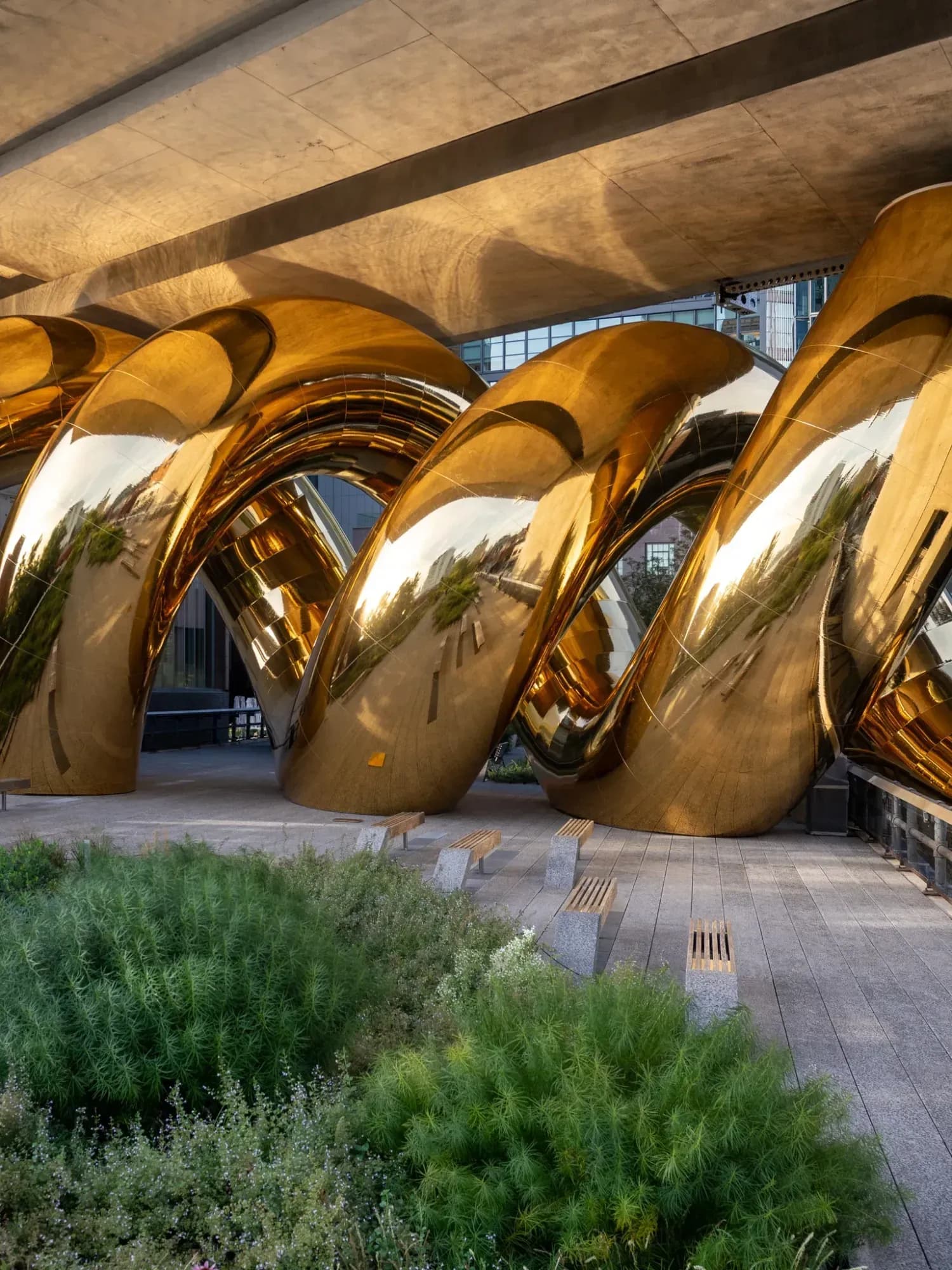
The Plinth is the only site on the High Line given over entirely to a rotating series of new monumental commissions, and it is now in its eighth year on view. Simone Leigh's Brick House inaugurated it in 2019. Sam Durant's Untitled (drone) followed in 2021, then Pamela Rosenkranz's Old Tree, then Iván Argote's Dinosaur. Tuan Andrew Nguyen's The Light That Shines Through the Universe is the fifth and went up in April 2026, where it stays through fall 2027. A sixth has already been chosen from the same round and will be announced in 2027.
Each cycle runs on a long fuse. The first two commissions were initiated in 2016, drew more than 50 proposals, and produced a shortlist of 12 artists who exhibited maquettes on the High Line in 2017. A second cycle opened in 2020 with 80 proposals posted online for public feedback and another shortlist of 12 maquettes in January 2021. Nguyen's work was selected from more than 56 proposals in a later round.
This round follows the same shape. In fall 2026 High Line Art will cut the 62 proposals to a shortlist. Those artists will be invited to present maquettes in a public exhibition in early 2027. Two will be built. The rest become what the Plinth quietly accumulates every cycle: a record of what a large number of serious artists thought a monument should be at a particular moment.
The nominating committee is worth reading as a document in itself. It includes Diana Campbell Betancourt of the Samdani Art Foundation, Amanda Carneiro of MASP and the 37th Bienal de São Paulo, Emma Enderby of the KW Institute for Contemporary Art in Berlin, Stefanie Hessler of the Swiss Institute in New York, Jamillah James of the Museum of Contemporary Art Chicago, Storm Janse van Rensburg of the Javett Art Centre in Pretoria, Venus Lau of the Museum of Modern and Contemporary Art in Nusantara in Jakarta, Miguel A. López of the Museo Universitario del Chopo in Mexico City, and Ekow Eshun, who chairs London's Fourth Plinth Commissioning Group. That last name is the tell. The High Line's own materials describe the Plinth as inspired by Trafalgar Square, and this round makes the relationship explicit.
The city keeps showing up as a fruit
Artists working independently, on different continents, kept arriving at the same object.
Kathleen Ryan proposes Red Delicious, a monumental apple core with a glossy red exterior and an interior of abalone shell, crystals and stone. Ali Cherri proposes Apples in a White Bowl, a cement bowl holding oversized bronze apples in advanced states of decay. Both explicitly invoke the Big Apple. Both are about rot. Ryan's core reflects a city "where excess and waste coexist, and where beauty and decay are inseparable." Cherri drags a domestic still life into public space and lets it turn.

Then there are the piggy banks, and they point in opposite directions. Rodney McMillian's Piggy Bank is a 23-foot pig with a black protrusion extending from its body, suggesting malignant growth, drawing on histories of redlining and predatory lending. Cinthia Marcelle's Economia de Base inverts the pig and sets it on a metal safe that collects coins deposited by the public, drawing on the Black Panther Party's community survival programs, with the accumulated funds redistributed.


One sculpture diagnoses American wealth as a tumor. The other asks the public to fill a pig with money and give it away. Same object, opposite politics, same open call.
Who bought Manhattan, and with what
A cluster of proposals goes after the founding transaction directly. Wendy Red Star's One Blue Bead stacks four monumental trade beads, from Venetian chevrons to beads tied to westward expansion and the myth of Manhattan's purchase, tracing how value, land and identity were shaped through trade.

Kei Imazu's Current takes a less familiar transaction: the 1667 Treaty of Breda, which ended the Second Anglo-Dutch War on the principle of uti possidetis, each side keeping what it already held. England kept New Netherland, Manhattan included. The Dutch kept Surinam and Run, a nutmeg island in the Banda archipelago. The popular framing is that Manhattan was traded for Run. No such swap was executed, and historians generally weigh New Netherland against Surinam rather than against Run. Imazu layers oyster shell, nautilus and suspended oceanic imagery to trace how land became a resource inside global systems of trade and extraction, with air plants at the top standing in for the present city.

Sung Tieu, the only artist in the round advancing more than one proposal, submitted Gunter's Chain and Refuge Bag. The first enlarges a 17th-century surveying tool, recalibrated to the proportions of the Statue of Liberty and presented unbroken, in pointed contrast to the broken chains at the statue's feet. It is a monument to the act of measuring land, and to the question of who gets access once land has been measured and owned.

The second is a large-scale sculpture of a woven plastic bag, the checkered kind carried by displaced people worldwide, its surface UV-faded and worn. Placing it on a former freight line is the whole argument: a site built for moving goods, now a park, hosting a container built for moving a life.

Kevin Beasley's Housing (Fragment) stays closer to home. It is a full-scale sculptural fragment of a New York brownstone cast in resin and locally sourced clothing, its façade and stoop reproduced on one side and sealed behind layered resin panels on the other. An iconic residential form, presented as partial and closed.

Monuments that refuse to stand up straight
Where these proposals invoke the monument as a form rather than just a scale, it is almost always in order to argue with one. David Zink Yi reduces the equestrian statue, the oldest cliché in public sculpture, to a vertical stack of four enlarged horse hooves cast in recycled aluminum. Cannupa Hanska Luger's TROPHY reads as a victory column from a distance and resolves up close into a raptor and serpent whose human faces are locked in a kiss, rendered in silver, the color of second place. Raphaela Vogel replaces the blindfolded figure of Justice with a seeing one. Selma Selman grounds two recycled airplane wings and paints sleeping female figures across them, reinterpreting the Winged Victory of Samothrace as stillness rather than flight.
Enrico David's Sleepwalker: Honouring the Tired is the clearest statement of the mood. It is a folded figure with a glowing onyx face and a second figure leaning at its base, proposed as a quiet monument to exhaustion, specifically the exhaustion of living in New York.
Laure Prouvost's seven-armed terrazzo figure reimagines monumentality as softness and multiplicity. Tau Lewis goes the other way and builds an 18-foot Inanna, the Mesopotamian goddess of love, war and political power, from materials designed to degrade over time.

The ones people will photograph
Some proposals are frankly built for the camera, which on a public plinth is not a criticism.
Heather Phillipson's Mama puts an American mastodon on the Plinth as a giant melting pink candle, with a rocket-shaped candle blasting from its back. It is prehistoric loss and aerospace mania in one object, and New York has the mastodons to justify it, with more than 150 recovered across the state.

Nina Chanel Abney's HOLD is a flat, double-sided teddy bear with outstretched arms, a form that reads instantly as comfort until you learn what it is doing there. The work points to Holt Collier, the formerly enslaved hunter and guide whose role in Theodore Roosevelt's November 1902 hunt near Onward, Mississippi, produced the toy in the first place. Collier's hounds ran the bear down and he clubbed it and lashed it to a tree. Roosevelt declined to shoot it, judging that unsportsmanlike, and a Washington Post cartoon two days later turned the refusal into "Teddy's bear." The part the toy dropped is that the bear did not survive. Roosevelt ordered it killed with a knife to end its suffering.

Judith Hopf proposes a 27-foot steel dandelion in bright yellow and green, with leaf shapes at the base you can sit on. A pioneer species that grows in difficult conditions, scaled up until it is visible from the street.

Anicka Yi's Pelagic Pod is an 18-foot translucent pod rising from a dark concrete crater, made of tinted resin with a kelp-like surface and containing ten animatronic moths whose movements shift through the day. Yi describes it as a lantern of mortal wings lifted from the sea.

Serge Attukwei Clottey enlarges a Kufour Gallon, the yellow plastic container ubiquitous in Ghana, first used for transporting oil and later repurposed for water storage. Its dented form and central opening carry the record of repeated use.

Michael Rakowitz proposes something harder to categorize: a 30-foot replica of the conical dome of the Tomb of Ezekiel at al-Kifl, Iraq, built from an aggregate of pulped sacred materials sourced from both faith communities and designed to be ceremonially buried at the end of its run. A monument with a scheduled funeral. The tomb held simultaneous Jewish and Muslim worship for centuries, the most important Jewish shrine in Mesopotamia, and Muslims venerate the same figure as Dhu al-Kifl. No Jewish community has remained at al-Kifl since the exodus of Iraqi Jews in the 1950s. Renovations after 2003 that removed or plastered over Hebrew inscriptions drew international criticism. Rakowitz, whose family is Iraqi Jewish, is proposing to rebuild something that has already been partly erased.

The proposals that need the public to finish them
A meaningful subset of this round does not work unless people participate. Es Devlin's A Portrait of the Present is an evolving collective portrait generated from anyone who wants to contribute a face, combining drawing and machine learning so each portrait coexists with the next, visible day and night.

Joël Andrianomearisoa's Sentimental Garden asks people to name their favorite flower and translates each answer into an aluminum form. Priscilla Monge's Time-Crystal is a corten steel house with openings for visitors to insert flowers, which accumulate and fade. Jonathan Lyndon Chase's Love Seat is an oversized yellow sofa topped with two facing male heads, and it is for sitting on. Marcelle's pig wants your coins. Rakowitz wants you to walk through his arches.
Ryan Gander's Time Piece (for everyone, everywhere, forever) takes the opposite tack, presenting a double-sided digital clock reading 88:88 in fluorescent yellow with a flashing colon, alongside a black totem cycling through 500 time-based statements. Time as something observed rather than fixed.

What to do about it
The comment period is not decorative. High Line Art states that public feedback is integral to the process and that comments will be shared with the curatorial team to help inform the shortlist. Each proposal page carries three prompts: can you imagine this artwork on the Plinth, is it a good fit for the High Line, and is it a good fit for New York City and for our time.
Comments close September 8, 2026. The shortlist lands in the fall, the maquettes go on view in early 2027, and the winners go up in 2029 and 2030. Between now and then, the best way to read this round is as a survey: 61 artists from 37 countries, asked the same question at the same time, and a surprising number of them answered with fruit, money, water, and sleep.