
Aman Kyoto
In 1615 Tokugawa Ieyasu granted the calligrapher Honami Koetsu around seventy-four acres in the hills northwest of Kyoto, and Koetsu moved a community of artists and craftsmen onto it. Scholars still disagree about whether the grant was a favour or a quiet exile. The colony was disbanded after his death and the land went back to the shogunate. Aman's restaurant here is called Taka-an, after him.
The resort's own site arrived by a stranger route. An obi collector, one of the most respected in Japan, bought the valley to build a museum for his textiles. He cut platforms into the slope, laid stone paths between them and had granite boulders brought in and set as sculpture. Then he stopped. The museum was never built, the forest took the terraces back, and for decades the garden sat there finished and empty.
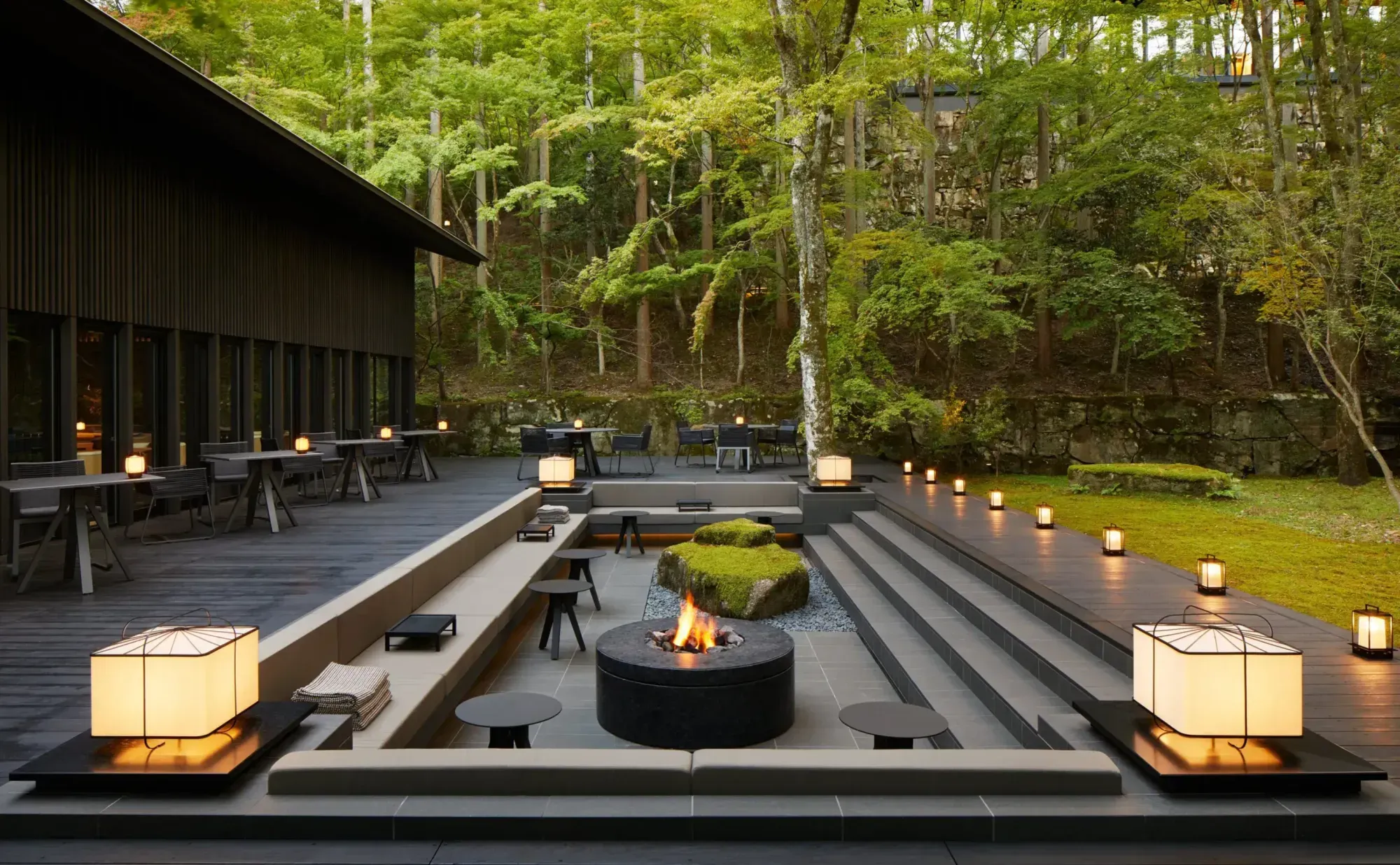
Kerry Hill built into what was already there rather than clearing it. Eight acres of garden inside seventy-two acres of standing forest, the platforms reused as foundations, the collector's boulders left where he had put them, the moss left alone. Twenty-six rooms, suites and pavilions are distributed across the valley as separate latticed buildings, so the resort never gathers into a single mass and is never visible whole. Washigamine sits highest and furthest apart. It was Hill's last project, finished by his practice after his death in 2018, and it opened on 1 November 2019.
The Living Pavilion keeps a fire at its centre and opens onto the garden terrace through glass. The onsen runs on mineral spring water. Kinkaku-ji is nearby, and most of what a room shows you is maple, moss and the slope of Hidari Daimonji above. The stones were chosen by a man assembling a museum that never opened. They are doing the job now.
The details
- Category
- Hotel
- Address
- 1 Okitayama Washimine-cho, Kita Ward, Kyoto, 603-8458, Japan
- Phone
- +81 75-496-1333
- Website
- aman.com


