
Beautiful Hotels in London
London built its hotels on purpose. Six of these seven went up to be hotels and nothing else, four of them in the seventeen years between 1889 and 1906, and only the Old War Office came to it late, after a century of government use. No two were drawn by the same architect, so the thread is an owner instead: Richard D'Oyly Carte opened the Savoy in 1889 beside his own theatre, hired César Ritz to manage it and Auguste Escoffier to cook in it, bought Claridge's in 1893 and had it rebuilt, then dismissed both men in March 1898, after investigators hired by the board found missing wine and spirits and kickbacks from the hotel's suppliers. Ritz put his name on Piccadilly eight years later. The kitchens are the other measure: three Michelin stars at Hélène Darroze, two at the Ritz, two at Brooklands, and one each at Pavyllon, the OWO and the Savoy, where the starred room is called 1890 after the year Escoffier arrived. These are the seven stays worth planning the trip around.
Map
The Savoy
Claude Monet stayed three times, in 1899, 1900 and 1901, painting Waterloo Bridge and Charing Cross Bridge from his window each time, from the sixth floor in 1899 and the fifth floor after that, and the river front he worked from was refaced in artificial stone a decade later. He worked in pastel on the first visit, on materials bought on Charing Cross Road while his canvases and paints came over from France, and more than twenty five of those survive. Richard D'Oyly Carte built the place beside his own Savoy Theatre, out of the profits of the Gilbert and Sullivan operas and on the American model, and Thomas Collcutt faced the blocks in Doulton's Carrara ware under green pantile roofs. The extension of 1903 to 1904 moved the front door round to Savoy Court, where the entrance stands between coupled Doric columns in polished black and buff stone. Howard Robertson covered the forecourt in 1929 with a latticework awning of bolted steel beams filled with glass, frosted lanterns hanging inside it. Traffic turning in off the Strand keeps to the right. Two schemes sit alongside each other upstairs. The Edwardian half runs to 162 of the 263 rooms and suites, grey and tangerine carried through as far as the Nespresso machines, and some of those look over the water to the railway bridge into Charing Cross. The Art Deco rooms take the Strand side, geometric and highly polished, worked around the hotel's own green. A butler comes with the River View suites. The American Bar first appears in the record in 1903, though a barman named Frank Wells was pouring American drinks at the hotel before that, and framed black and white photographs of past visitors hang on its cream walls. Ada Coleman came over from Claridge's the same year and made the Hanky-Panky for the actor Charles Hawtrey, still poured to her recipe; Harry Craddock, who replaced her when the bar reopened in 1926, gathered some 750 drinks into The Savoy Cocktail Book. Joe Gilmore mixed the Moonwalk in 1969 and sent it to the Apollo 11 crew. By his own account they drank it after leaving quarantine on 10 August, seventeen days after splashdown, and Armstrong wrote back to thank him.
Booking through this link earns us a commission. It costs you nothing extra, and no hotel has paid to be selected.
Claridge's
Five storeys of basement went in under the art deco wing without the works closing the hotel, and every load of material passed through a single window opening rather than cross the building. Three floors down is Claridge's first swimming pool, set between two rows of limestone columns under a multi-vaulted ceiling. C. W. Stephens designed the present hotel, built between 1895 and 1898 for the Savoy Hotel Company, in red brick and red Mansfield stone with cast iron balconies, on the corner of Brook Street and Davies Street. Oswald Milne set a Portland stone entrance into the Brook Street front in 1929 and extended the hotel in 1930 and 1931. His ballroom followed in 1933. The art deco arrived thirty years after the bricks. The front hall runs black and white marble in wide diamonds past a chimneypiece and a three bay arcade into the Foyer, where a Chihuly hangs above the deco mirrors and afternoon tea comes out on jade and white stripes. The Fumoir is a deco room Thierry Despont invented in the 1990s, lit through Lalique crystal panels, with William Klein portraits watching over it. In the ballroom, the chandeliers are replicas of bakelite originals. Suites move from Victorian to deco to plain modern, and a stained glass panel of Damien Hirst's butterflies is set into the ceiling above the main staircase, seven flights up. Rémi Tessier's penthouse takes the entire roof: four bedrooms, seventy five Hirst works on loan from the artist and a nine metre heated pool of its own. Claridge's has been listed since 1981.
Booking through this link earns us a commission. It costs you nothing extra, and no hotel has paid to be selected.
The Connaught
In front of the entrance, trees rise out of a granite basin, and four times an hour a mist lifts around their trunks and holds for fifteen seconds. Tadao Ando designed it, and it was finished in 2011. Most of what happens at this hotel happens on the far side of that door, in its public rooms. The staircase that climbs out of the lobby was copied for Ralph Lauren's Madison Avenue flagship. It belongs to a building put up between 1894 and 1897 as the Coburg, on the site of the Georgian houses in Charles Street that had served as the hotel since 1815, after the Duke of Westminster redrew that street into Carlos Place. The name changed during the First World War, to Queen Victoria's son Arthur, Duke of Connaught. The bar overlooking Carlos Place kept the old one. There are three bars, not counting the Champagne Room. The Connaught Bar, platinum silver leaf on the walls and a 1920s Cubist look to the scheme David Collins Studio drew for it, has been open since 2008, takes no reservations, and builds its martini off a trolley set with the makings and a rank of bitters, on a gin blended for the house. Through a velvet curtain off the Champagne Room, the Red Room keeps a pink onyx bar and Louise Bourgeois's I Am Rouge. The Coburg pours whisky from nine in the morning. Hélène Darroze has cooked here since 2008, to menus built on producers she has worked with for decades. Down a corridor clad in rosewood, the Connaught Grill grills over hardwood charcoal and apple wood embers in an open kitchen, carves the Sunday joint off a silver trolley and finishes the crêpes suzette in flame at the table. Jean-Georges Vongerichten shaped it, and his name is on the room facing Mount Street. An Aman spa holds five treatment rooms, a pool and a steam room inside the building, and a butler comes with every room. Downstairs, little else needs a room key.
Booking through this link earns us a commission. It costs you nothing extra, and no hotel has paid to be selected.
The Ritz London
The lion is on the flag outside, on the blue dome over the entrance, and again on the mat underfoot. It repeats in green copper at the corners of the mansard roof, which stands clear of the trees on the Green Park side. Charles Mewès and Arthur Davis raised what amounts to a Parisian apartment block on Piccadilly, granite along the ground floor and Portland stone above, set over an arcade modelled on the Rue de Rivoli that people still walk under coming from Green Park station. César Ritz gave it his name and had a hand in the planning, but a collapse in 1902 had ended his working life and he was not running the hotel when it opened in 1906. The interiors run to Louis XVI throughout. Very little about the architecture is English. The rooms keep the Edwardian scheme rather than update it, with period furnishings, richly woven carpets, hand-finished mouldings, and silk on the walls a category up from the 452-square-foot deluxe. Beds are Sleepeezee, which holds a royal warrant of its own, and the marble bathrooms have heated floors. A panel at the bedside works the lights and the blinds. Tea is served five times a day, from half past eleven until half past seven, and no gentleman sits down to it without a jacket and tie. Twenty loose-leaf teas are on the list, sourced by the hotel's tea master, Giandomenico Scanu, who travels out to the plantations himself, and the Ritz Royal Blend is poured nowhere else. Cake comes last, wheeled over on a trolley and cut at the table. John Williams runs the kitchen as executive chef, and in 2025 the National Restaurant Awards named the restaurant their National Restaurant of the Year. It placed joint second in 2026. The Rivoli Bar keeps its restored vaulted ceilings picked out in hand-painted gold. The royal warrant the hotel holds covers banqueting and catering, granted in 2002 and granted again by King Charles III in 2024. He granted the first one too.
Booking through this link earns us a commission. It costs you nothing extra, and no hotel has paid to be selected.
Raffles London at The OWO
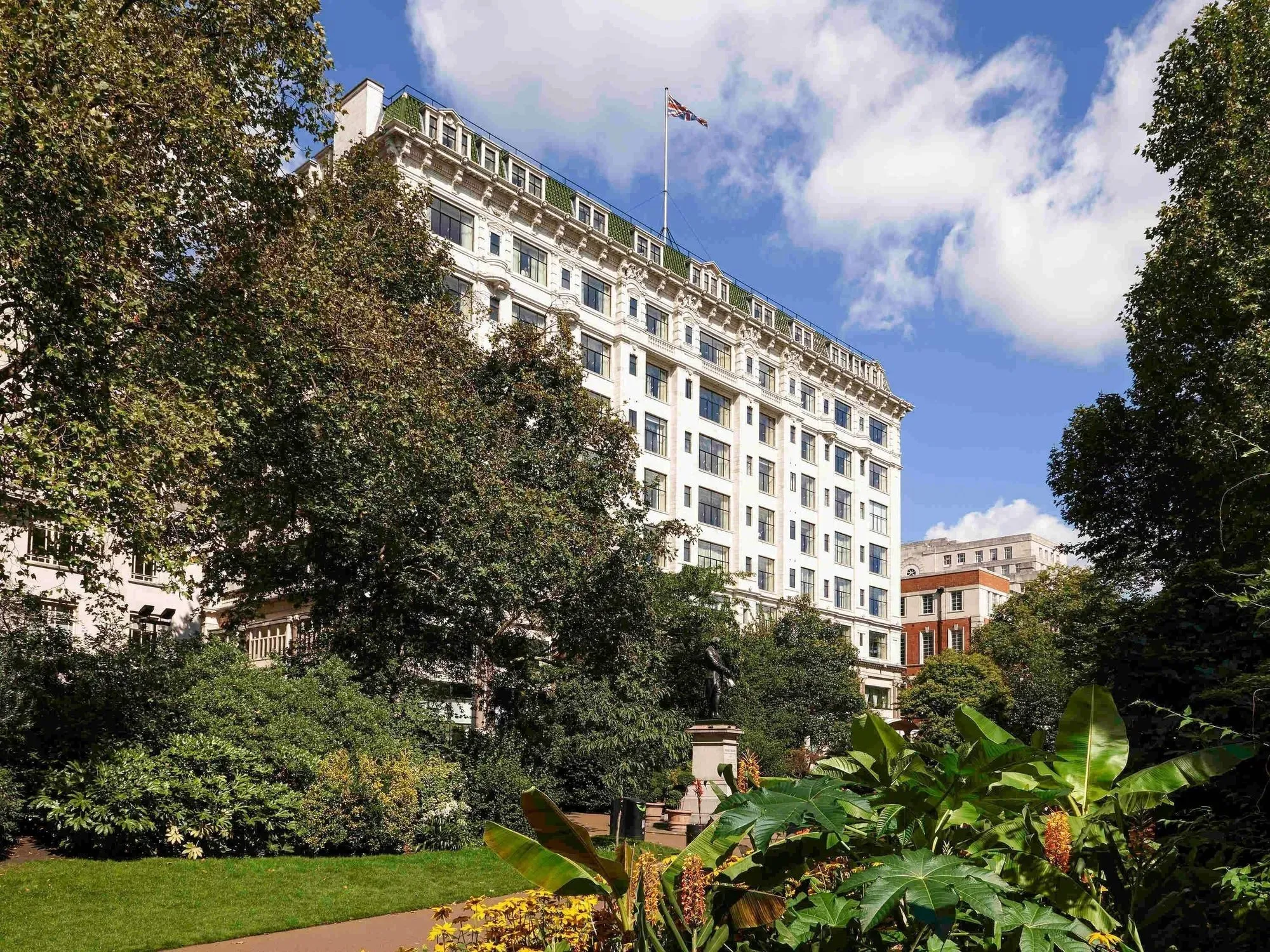
The four corners were bowed and capped with domes to disguise an irregular site, and the suites below those turrets carry the names of women from Britain's wartime intelligence and political life, among them the SOE officer Vera Atkins. What opened on Whitehall in 1906 was a Portland stone block of more than a thousand rooms and two and a half miles of corridor, drawn by William Young in 1898 and finished, after his death two years later, by his son Clyde and Sir John Taylor. Churchill ran the department from here as Secretary of State for War, and the building appeared in five Bond films, standing in for MI6 headquarters in the first three. The Whitehall door opens on a low hall and then the staircase, which starts in one flight and divides to climb three walls of a compartment domed and glazed to the sky, its steps Piastraccia marble, its balusters English alabaster, its handrails Brescia. Thirteen eighteenth-century chimneypieces, bought in 1904 from the department's old premises in Pall Mall, were reset in the offices. Thierry Despont, who had earlier worked on the Statue of Liberty, took the 120 rooms and suites, five of them Heritage Suites in offices that political and military leaders once used. The Haldane, once Churchill's, joins its neighbours into a six-bedroom wing that sleeps twelve. Four floors go to the Guerlain Spa, three of them underground, where a twenty-metre pool sits under a double-height ceiling. The Guards Bar sits in one of the rounded corner pavilions, oak-panelled, its bar stools in red leather, with its own entrance facing Horse Guards. The Spy Bar forbids photography.
Booking through this link earns us a commission. It costs you nothing extra, and no hotel has paid to be selected.
The Peninsula London
The two Japanese maples in the courtyard are a hundred and twenty years old, held in Hyde Park when they arrived so they would take to the climate before anyone planted them here. They stand on the cobbles, jasmine and wisteria climbing the walls above, the house cars drawn up alongside. Hopkins Architects built the place new to sit with its heritage neighbours, and Peter Marino drew the rooms, the lobby and the two floors of spa underneath. All 190 rooms and suites have a mahogany-panelled dressing room and a bathroom of honey onyx and marble. The pictures in them are landscapes, commissioned from more than forty artists at the Royal Drawing School. Higher floors turn towards Hyde Park Corner. The Arch Suite opens Juliet balconies straight onto Wellington Arch, while the Peninsula Suite takes 470 square metres of the sixth floor, with a fireplace and a baby grand in the living room, a private gym, a thirteen-seat screening room and a lift of its own. A telescope stands in the larger of its two living rooms. Brooklands sits on the eighth floor with a scale model of Concorde hung above the dining room and Claude Bosi's kitchen under it. The bar beside it takes its latticed ceiling from the geodetic airframes Barnes Wallis designed at Brooklands, and its chandelier fans out glass blades in the shape of a jet turbine. Canton Blue does Cantonese on the ground floor, and The Lobby carries de Gournay murals of the Royal Parks. The 25-metre pool sits in a double-height room underground, its upper walls tiled in mosaic tree canopies and its light coming from panels in the ceiling. That daylight is manufactured.
Booking through this link earns us a commission. It costs you nothing extra, and no hotel has paid to be selected.
Four Seasons Hotel London at Park Lane
The Terrace Rooms sit on the second floor and open onto a landscaped terrace they share, planted and half enclosed, with the roofline of the building opposite standing just above the planters. The Premier Park-View Rooms run from the fourth floor to the ninth, 35 square metres each and panelled in walnut veneer, while the fifth-floor Presidential Suite keeps a fireplace of its own. One park-side corner is glazed on both walls, two chairs at the join. The Hyde Park Suite takes the ninth. Yannick Alléno's Pavyllon London seats 95, with counter seating over the open kitchen. The menus change constantly, French technique turned toward seasonal British produce. Bar Antoine, named for his late son, pours until one in the morning six nights a week and keeps a pétanque court on its terrace through the summer. Chahan Minassian drew both rooms, panelling the bar in wood and upholstering its seating in bouclé, mohair velvet and woven silk. The bar's terrace seats thirty. The spa is on the top floor, ten storeys up and 900 square metres of it. Nine treatment rooms are glazed to the floor and face the park and Westminster, each with a relaxation pod of its own. One of the nine is the double Sky Suite, 44 square metres with 180 degrees of the view. The vitality pools in the men's and women's wet areas are skylit, one of them set in grey slate. The sauna has a window.
Booking through this link earns us a commission. It costs you nothing extra, and no hotel has paid to be selected.


