
Beautiful Hotels in Kyoto
Kyoto rewards the traveler who stays inside the city rather than beside it. The finest hotels here were built around something that was already on the site: an eight-hundred-year-old garden laid out for a Taira commander, Edo-period teahouses lifted whole and set back down over a new foundation, the former Mitsui family residence facing Nijo Castle, a thermal spring drawn from the ground below the lobby. None of them rise above the tiled roofs of their district, and the best of them frame a pagoda, a river or the Higashiyama ridge in a window instead of competing with it. These are the seven stays worth planning the trip around.
Map
Park Hyatt Kyoto
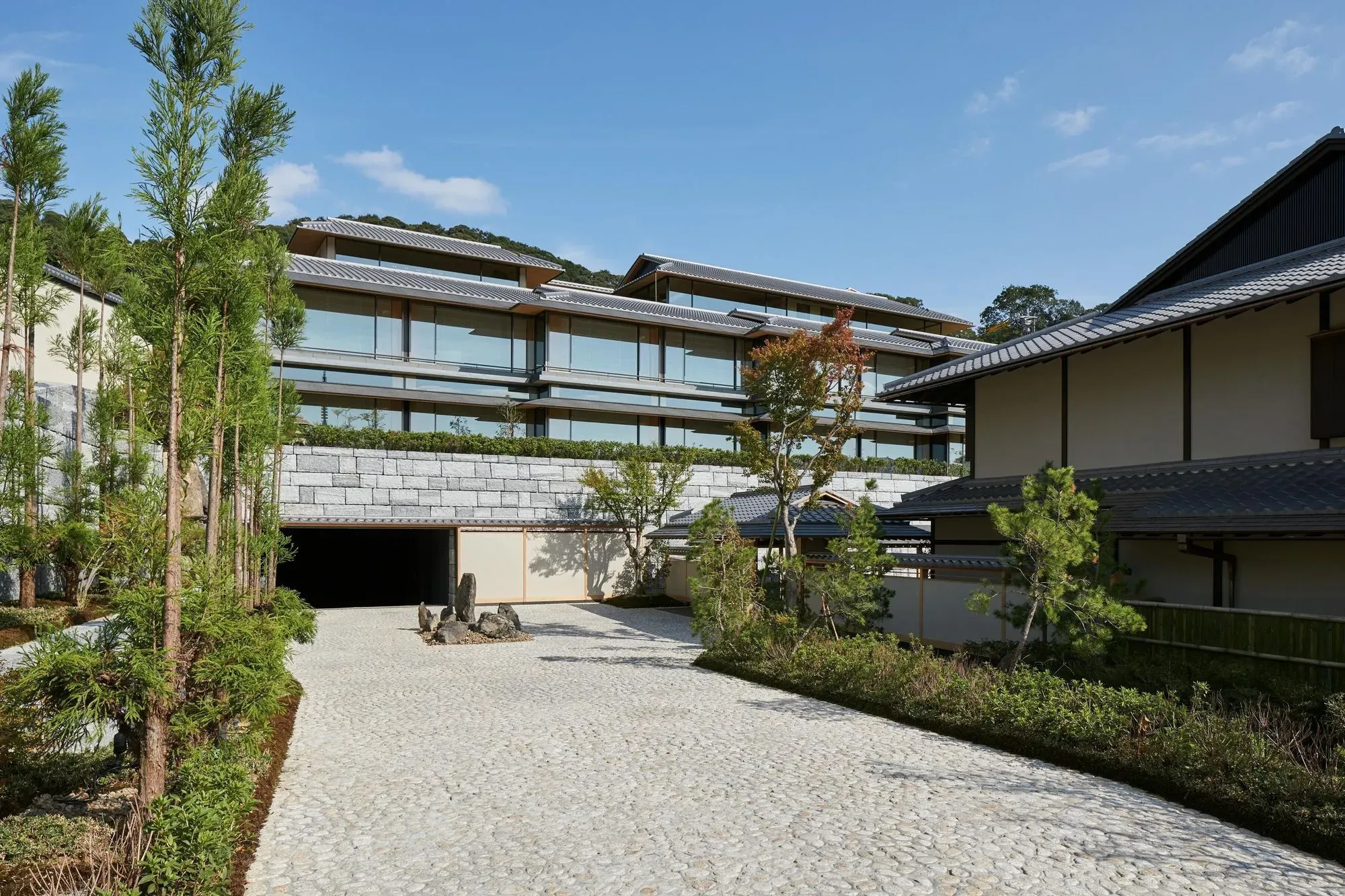
The stones in the entrance garden all travelled to get there. Some are around three hundred million years old and crossed the ocean from Aspen, Colorado, a gift from Hyatt's executive chairman. The others came from Horyuji Temple, by way of the Kyoyamato garden on the same grounds. Kyoyamato has served kaiseki on this slope of Higashiyama since 1949, and the same family runs it still, seven generations on. The hotel was built into its grounds rather than over them by Takenaka Corporation, which owns it and held the room count to seventy where the arithmetic of a profitable hotel usually runs past a hundred and fifty. The tiled roofs of the district still read as the skyline. Two of Kyoyamato's tearooms, Suiko-an and Koro-an, stood where the hotel had to go, and neither could be taken apart and put back without losing the thing that made it worth keeping. Both were hoisted whole on a crane and driven along the road at night, a few millimetres of misalignment being enough to snap a column. Suikokan was repaired rather than replaced, its columns rejoined by basara, the joint used on shrines and temples, and the clay that had flaked off its earthen walls reused. Soyo-tei, an Edo-period teahouse whose private room once hosted loyalist samurai in secret, went up the same way. Arrival is under a low tiled roof. Guest room eaves were set below the upper storey, so the garden sits level with the view out. Tamo wood carries through the rooms, which hold original artwork and look onto the gardens. The Living Room puts a gilded ceiling over a walnut reception desk and an open fire that leaves the scent of tamo in the air, and Kyoyamato cooks the Japanese breakfast. In the Pagoda House the roof runs out into the eaves, with Kyoto laid out beneath. It is the view from a mountainside.
Booking through this link earns us a commission. It costs you nothing extra, and no hotel has paid to be selected.
Four Seasons Hotel Kyoto
The path to the teahouse crosses a bridge of tempered glass, laid over ancient stonework so the arrangement below stays visible underfoot. Shakusui-en covers ten thousand square metres and runs long and narrow, west to east, where the Higashiyama mountains close the view. A stone bridge divides the large pond from the small one, and the waterfall was rebuilt from its original stones by following the measured drawings the garden scholar Mirei Shigemori made in the 1930s. Design characteristics from the end of the Heian period, together with a description in the Tale of the Heike, point to Komatsu-dono, the villa of Taira no Shigemori. A Jizo has stood here since the middle of the Edo era. The camphor tree is two hundred years old. Kume Sekkei set the hotel around all of it, and Hirsch Bedner Associates took the 123 rooms and suites, with 57 residences alongside. Washi-paper lamps, fusuma screens and urushi lacquerware carry the local craft indoors, where the windows give onto the garden, the courtyard or the city. The teahouse is sukiya-style, drawn by the local architect Ryosuke Yamamoto and built mostly in Kyoto cypress, with soil from Fushimi in the floor and the light coming through a Japanese umbrella on the ceiling. Its two rooms are Shakusui-tei and Fuju, which the priest of neighbouring Myoho-in Temple named after the poetic word for a maple. A maiko dances in the lobby at quarter past five on Tuesdays and Saturdays, and the spa keeps seven treatment rooms, a green tea therapy of its own and a twenty-metre indoor pool. Carp, turtles and herons live in the pond.
Booking through this link earns us a commission. It costs you nothing extra, and no hotel has paid to be selected.
The Ritz-Carlton, Kyoto
Water falls from the top of the levee at street level down to the swimming pool in the basement. Kyoto's height limits pushed the restaurants and the banquet rooms underground with it, and left all 134 guest rooms above, facing the Kamogawa and the Higashiyama hills. The bend of the Kamogawa at Nijo Ohashi has drawn Japanese nobility since the seventeenth century. Nikken Sekkei kept the building low against its neighbors as a contemporary reading of a Meiji house, and it opened in February 2014 for Sekisui House, with interiors by Remedios Studio and Design Studio Spin and 409 works of Japanese art set through it. Ebisugawa-tei, the all-hinoki villa Baron Fujita Denzaburo built in 1908, was taken apart and rebuilt inside, down to the zelkova tokonoma and the silver door pulls cut with plovers. It is a private dining room now. Seismic code left a deep beam across every window. Remedios Studio wrapped it in wood and lit it from behind, so the Higashiyama ridge sits framed like a stage, and put a daybed and a chest for tea ceremony where a desk would otherwise go. Rooms average 50 square meters, with carpet woven to look like tatami and cushions taken from Heian court kimono. Wet, the slatted hinoki floor smells of lemon. Suite Tsukimi sits at the top, its moon-viewing deck opening onto a garden lit by historic lanterns, Daimonji in the view. Suite Kamogawa gets a private balcony over the water on the second floor, and the Ritz-Carlton Suite runs to 212 square meters with a fireplace out on its own. Garden Terrace Suite TATAMI trades beds for futons. Below the entrance a garden runs up the wall toward the levee at ground level, and the daylight comes down with it to the floors where the pool and the first hotel spa in Asia to run on La Prairie sit under the rooms. Check-in is a cup of tea.
Booking through this link earns us a commission. It costs you nothing extra, and no hotel has paid to be selected.
Six Senses Kyoto
Fox heads of recycled washi paper line the guest room corridors, a button lighting either the whiskers or the eyes, doing the work a Do Not Disturb card usually does. Six Senses opened its first hotel in Japan in April 2024, beside a Higashiyama shrine, and the folklore runs through the whole building. The shrine is Toyokuni-jinja, founded in 1599 to honor Toyotomi Hideyoshi. Inside, the lobby ceiling folds like the concertina binding of the Tale of Genji manuscript, while a screen of 504 raku tiles from the Kiyomizu district frames the check-in desks and resolves into the silhouette of Kurama-yama. Genji was partly set there. Behind the bed stands a headboard wall of rotating panels, asanoha pattern on one face and Japanese red lacquer on the other, meant to be turned and rearranged rather than left as found. A shoji screen closes off the bathroom, where the wall tiles follow the lines of an oke bathing bowl and a kodo holder keeps incense moving through the room. A painted moon hides the television. All 81 rooms and suites carry a yoga mat, a pillow menu and an organic Naturalmat mattress, and they run from 42 to 238 square meters, looking out on the shrine gardens, the central courtyard or a panorama of treetops, temples and rooftops. Two of the suite types open straight onto a private Japanese garden, and the three-bedroom penthouse takes the top floor under vaulted timber ceilings, with a commissioned artwork mapping the Heian city grid. It sleeps six.
Booking through this link earns us a commission. It costs you nothing extra, and no hotel has paid to be selected.
Capella Kyoto
The way in is a long walkway flanked by shoji screens, which holds the arrival back until the courtyard opens at the centre of the building, a shallow pond ringed by rocks and a few trees. The 89 rooms are arranged around it. Kengo Kuma and Associates drew the four-storey building on the former grounds of Shinmichi Elementary School, one part of a redevelopment along Shinmichi Street that also put up a community centre and rebuilt the Miyagawa-cho Kaburenjo next door. A special permit let the theatre's great roof go back up at its old height, and the karahafu over the stage moved across into the new hall. Timber and light fittings pulled from the school went into Yoi, the late-night kappo restaurant. Brewin Design Office, working in Japan for the first time, took the machiya's run of narrow alley, hidden garden and interior threshold and stretched it across the whole plan, finishing in hand-washed plaster, cypress, cedar, paper and ceramic. A twisted form modelled on a Shinto shimenawa rope pushes out of one wall of the reception lobby. Rooms begin at 50 square metres, and the Premier Theatre Rooms take their name from the view of the Kaburenjo. The 206 square metre Capella Suite has the top floor, with the Yasaka Pagoda on the ridge beyond and the laneway to the ochaya below. Six of the 29 suites keep a private onsen bath against an inner garden. The Kaburenjo has been the private training ground of the district's geiko and maiko for generations, and it opens its front rows to the hotel for the classical arts still taught inside. On the same programme are a wooden sandal atelier of 150 years, where a pair is commissioned and made by hand, and a kintsugi session with an urushi master who mends what is broken into something better than it was. A maiko receives visitors in a private ochaya. That teahouse admits by invitation only.
Booking through this link earns us a commission. It costs you nothing extra, and no hotel has paid to be selected.
HOTEL THE MITSUI KYOTO, a Luxury Collection Hotel & Spa
A peach sits on the roof of the gate at the entrance, worked into one of the tiles. More than half the tiles up there are the original ones, wired down now rather than bedded in clay, for the earthquakes. The gate went up in 1703 for the Kajiimiya court, the Tendai household that is now Sanzen-in, and it spent years back in Ohara before reaching this address in 1935. Carpenters from Fukui took it down into roughly a thousand pieces and stood four fifths of the old timber up again. It was registered as a cultural property in 2021, the second building in the Mitsui group to be listed. Takahira Mitsui chose the ground because Nijo Castle stood next door, and his line held it for more than two hundred and fifty years. Shunsaku Miyagi rebuilt their garden at the centre of the property, some 1,300 square metres of it, working the old estate's stone lanterns and rocks back in. The path from the gate runs through bamboo before it reaches the lobby, where a wall of angled timber slats stands in for a hedge and a ceramic by Yukiya Izumita sits in raked sand. SHIKI-NO-MA reconstructs the okusho-in of the old house in Japanese cypress. André Fu took the tearoom as his model for the 160 rooms, which run to custom walnut cut with interlocking joints, washi shades made by local artisans, and woven wall panels by Jotaro Saito, who comes out of a family of Kyoto kimono dyers. Every bathtub is rough-cut stone, long enough to lie down in. The spring the hotel draws on lies a thousand metres straight below the property, feeding a thermal pool where bathers wear swimsuits and, in the two Onsen Suites, an outdoor bath off a private garden. One group of guests a morning walks into Nijo Castle fifteen minutes before it opens to anyone else. The Nijo rooms look straight at it.
Booking through this link earns us a commission. It costs you nothing extra, and no hotel has paid to be selected.
ROKU KYOTO, LXR Hotels & Resorts
The pottery class works with clay from the hotel's own grounds, shaped by hand under a Kyoto ware kiln master. Firing takes two months, so the finished piece follows long after the stay has ended. Tokugawa Ieyasu granted this stretch of Takagamine to Hon'ami Koetsu in 1615, and Koetsu moved a village of artists and craftsmen onto it. What he and Tawaraya Sotatsu made there is where Rinpa begins, though the style was consolidated some fifty years later by Ogata Korin, whose name it eventually took. That naming came in the Meiji period. Roku opened in September 2021 as the first LXR in Asia Pacific, in the southern part of the 28.6-acre Shozan Resort at the foot of the three Takagamine peaks, with the Tenjin River running through the grounds. Clint Nagata and BLINK Design Group built the interiors around the idea of an artist's residence, putting lacquerware at the entrance and karakami paper in all 114 rooms. In the spa the ceramic wall takes the shape of bamboo. The Takagamine Deluxe runs fifty square metres behind floor-to-ceiling glass, the gardens and a water basin below and the mountains past them, while the Onsen Garden Rooms trade that outlook for a seventeen-square-metre courtyard and a semi-open-air bath fed from the hot spring. Four Poolside Terrace Rooms sit beside the spa with thirty-three square metres of terrace each, opening onto the thermal pool, which draws natural hot spring water from the Shozan grounds and runs all year. Both suites go to a hundred. That river is also called the Kamiya-gawa, after the paper guild that worked its banks in the Heian period, and the hotel took its name from roku, the word for making paper by hand. The session held on the grounds works selected ganpi fibre, with an artist guiding it. A priest comes from a nearby temple for morning zazen under the eaves of a reception pavilion out in the Shozan gardens. Kinkaku-ji is a walk away.
Booking through this link earns us a commission. It costs you nothing extra, and no hotel has paid to be selected.
Aman Kyoto
In 1615 Tokugawa Ieyasu granted the calligrapher Honami Koetsu around seventy-four acres in the hills northwest of Kyoto, and Koetsu moved a community of artists and craftsmen onto it. Scholars still disagree about whether the grant was a favour or a quiet exile. The colony was disbanded after his death and the land went back to the shogunate. Aman's restaurant here is called Taka-an, after him. The resort's own site arrived by a stranger route. An obi collector, one of the most respected in Japan, bought the valley to build a museum for his textiles. He cut platforms into the slope, laid stone paths between them and had granite boulders brought in and set as sculpture. Then he stopped. The museum was never built, the forest took the terraces back, and for decades the garden sat there finished and empty. Kerry Hill built into what was already there rather than clearing it. Eight acres of garden inside seventy-two acres of standing forest, the platforms reused as foundations, the collector's boulders left where he had put them, the moss left alone. Twenty-six rooms, suites and pavilions are distributed across the valley as separate latticed buildings, so the resort never gathers into a single mass and is never visible whole. Washigamine sits highest and furthest apart. It was Hill's last project, finished by his practice after his death in 2018, and it opened on 1 November 2019. The Living Pavilion keeps a fire at its centre and opens onto the garden terrace through glass. The onsen runs on mineral spring water. Kinkaku-ji is nearby, and most of what a room shows you is maple, moss and the slope of Hidari Daimonji above. The stones were chosen by a man assembling a museum that never opened. They are doing the job now.


