A Pagoda in the Window, an 1877 Ryotei Next Door: Park Hyatt Kyoto
Park Hyatt Kyoto shares a hillside off Ninenzaka with Kyoyamato, a ryotei founded in 1877. Held to 10 meters above ground, it went four floors down instead, and the quiet that bought runs through everything from the entrance garden's Colorado stones to a breakfast cooked by a two-MICHELIN-star kitchen.
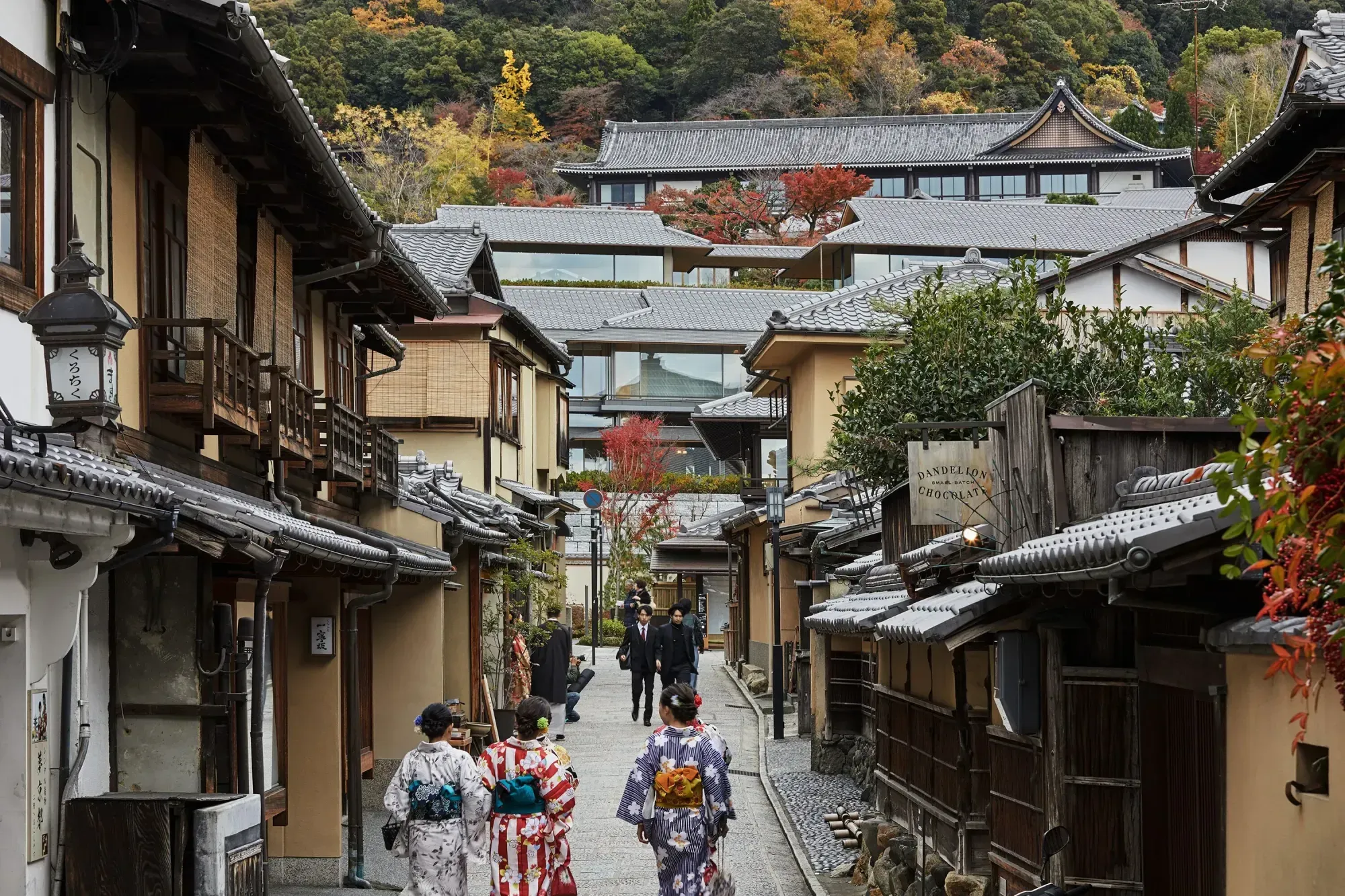
Ninenzaka fills early. By mid-morning the stone steps below Kiyomizu-dera carry a steady climb of visitors past wooden machiya selling pottery, matcha and souvenirs, and the noise of it carries. Park Hyatt Kyoto opens directly onto this slope. A few steps through its gate the crowd and its sound fall away, and what is left is moss, stone and a dark path through a garden.
The quiet is not an accident of the site. It was planned, dug and in places paid for in centimeters, and most of what makes the hotel worth the stay follows from one rule: on this hillside, nothing may stand taller than 10 meters.
The hotel opened on October 30, 2019, the second Park Hyatt in Japan after Tokyo. It has 70 rooms, nine of them suites. We stayed two nights at the start of October, hosted by the hotel, and the attention to detail did not slip once.
A hillside with twelve centuries of history
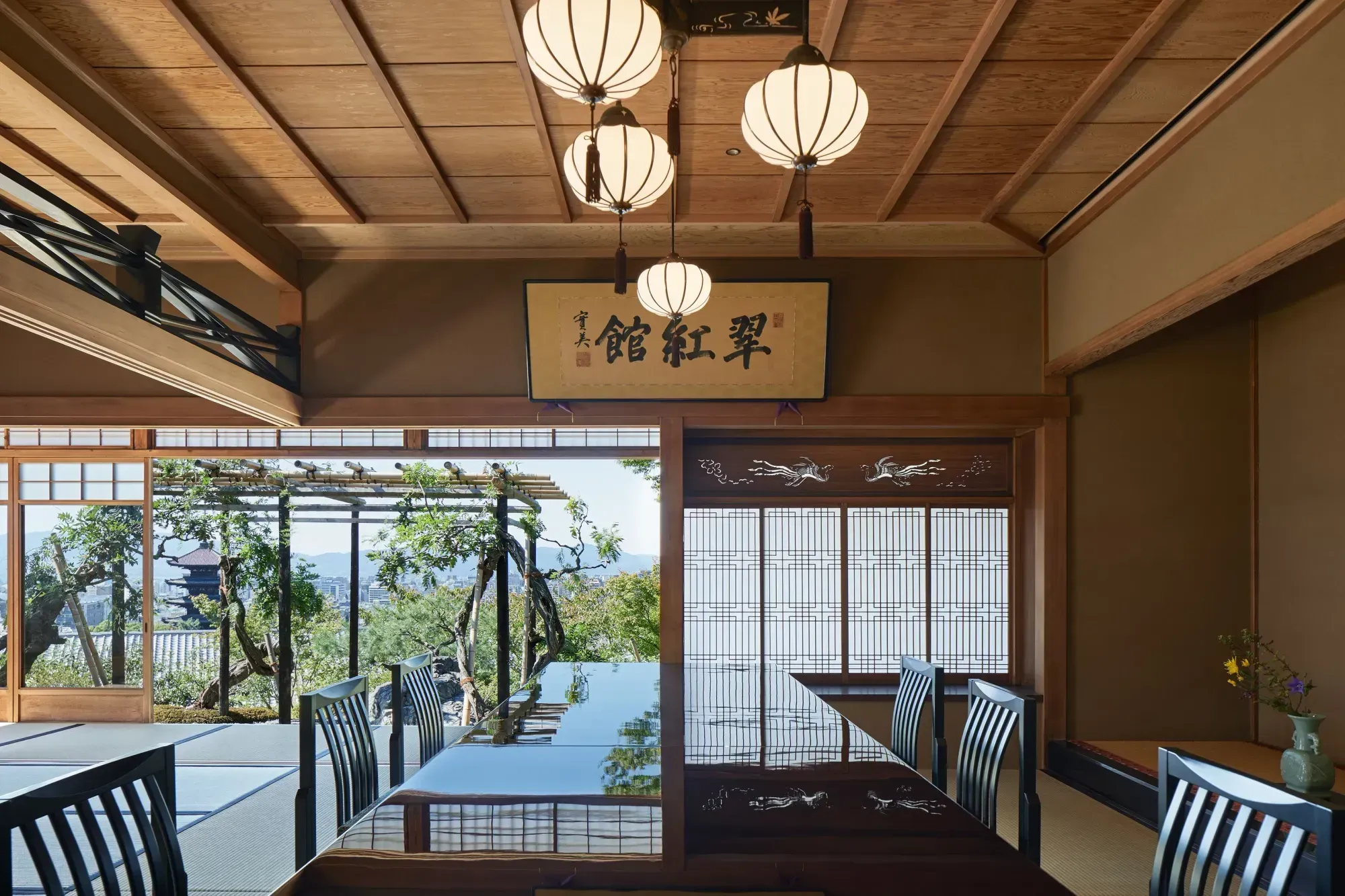
The hotel shares its land with Kyoyamato, a kaiseki ryotei. Kyoyamato was founded in Osaka in 1877 and opened on this hillside beside Kōdai-ji in 1949. Junko Sakaguchi, the seventh generation of her family to run it, has led it since 2017. The restaurant holds two MICHELIN stars, and in 2025 the guide gave Sakaguchi its Service Award.
The land is far older than either business. In the 780s a sub-temple of Shōhō-ji stood here, and in the Kamakura period it became a court noble's villa. It later passed into the holdings of Nishi-Honganji. In the final years of the Edo shogunate, loyalists including Katsura Kogorō and Kusaka Genzui met here in secret. After the Meiji Restoration the property changed hands several times, and in 1948 it passed to the Sakaguchi family, who opened Kyoyamato here the following year.
The hotel came out of a friendship between three parties: Kyoyamato, the builder Takenaka Corporation and Hyatt. Takenaka traces its roots back more than 400 years to a master carpenter of shrines and temples. From 2016 until the opening, the three partners met every month, more than 50 times in all.
The restoration was carpentry as much as construction. Kyoyamato's historic buildings were raised off the ground so an earthquake-resistant foundation could be laid beneath them, and its Koro-an tea room was lifted by crane. Some of the new timber was felled on a winter new moon, following an old belief that wood cut then lasts longer. Repairing the old buildings sent the team into the woods for Chinese cork oak, a timber no longer sold on the market. Even the garden's forest green tree frogs were looked after: before work began, the team collected their eggs from Kyoyamato's pond, raised them, and released the frogs back into the garden when construction ended.
Ten meters, and four floors down
Higashiyama is a scenic preservation zone, and on this site no building may rise higher than 10 meters. Takenaka's answer was to dig. Above ground the hotel has two floors. Below it there are four, and they hold about 60 percent of the floor area.
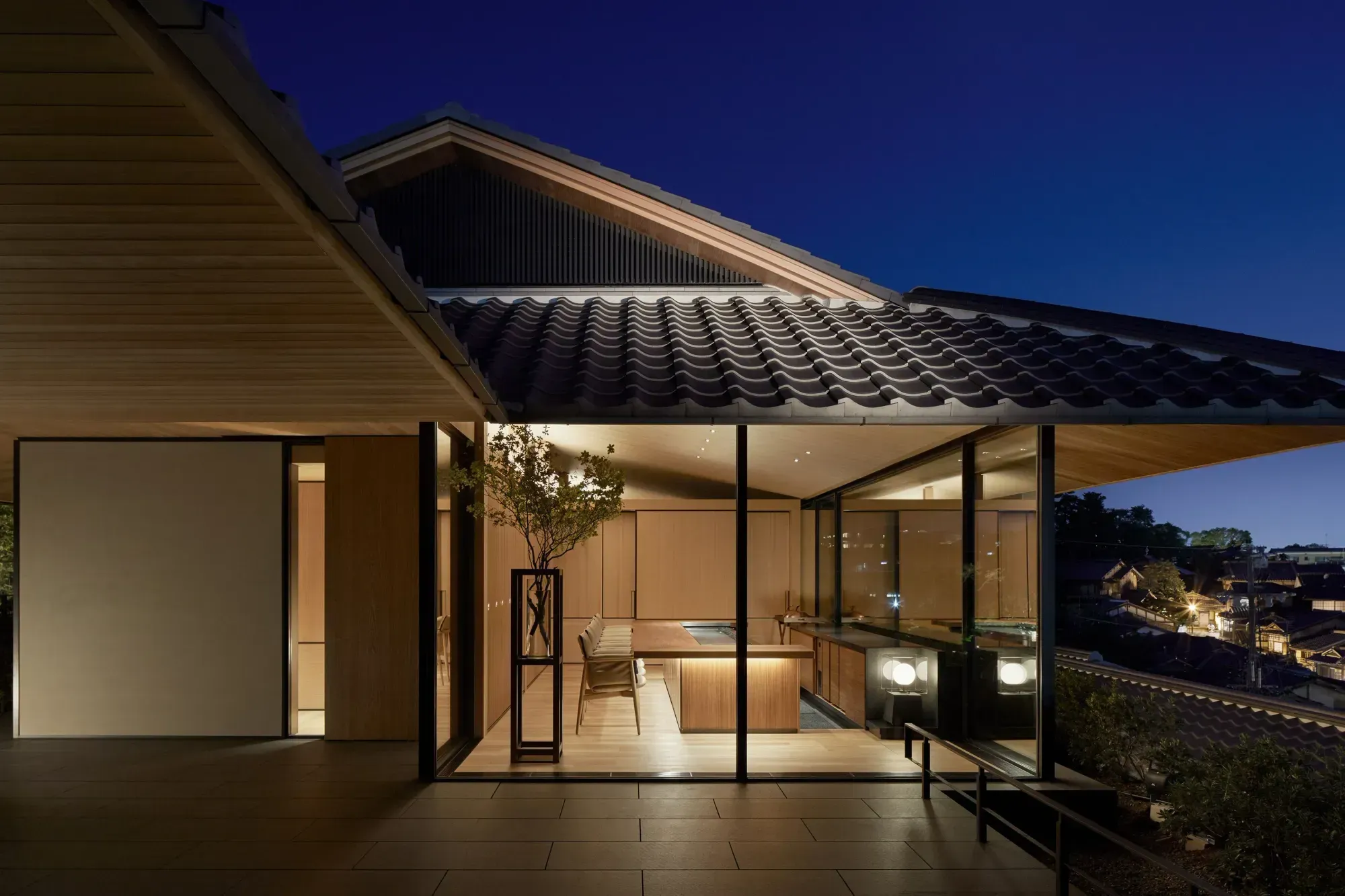
The site runs 150 meters deep and climbs 28 meters from front to back, and its eastern edge was once designated a landslide risk zone. Takenaka built a retaining wall 61 meters long and 13 meters high, and the designation was lifted. Above it, the hotel follows the slope as a cluster of low wings stepping up the hill, roofed in tile at the pitch of the machiya below.
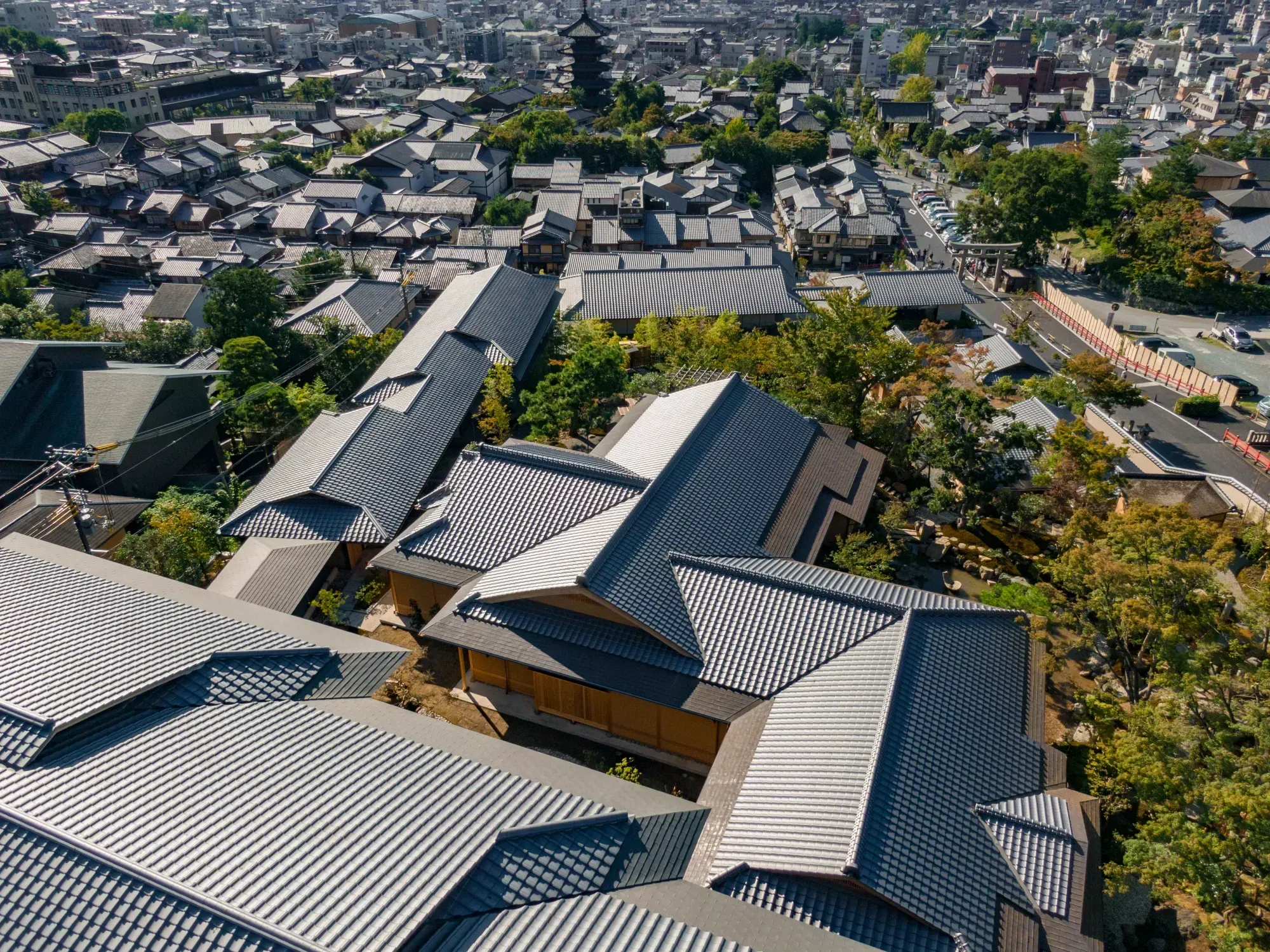
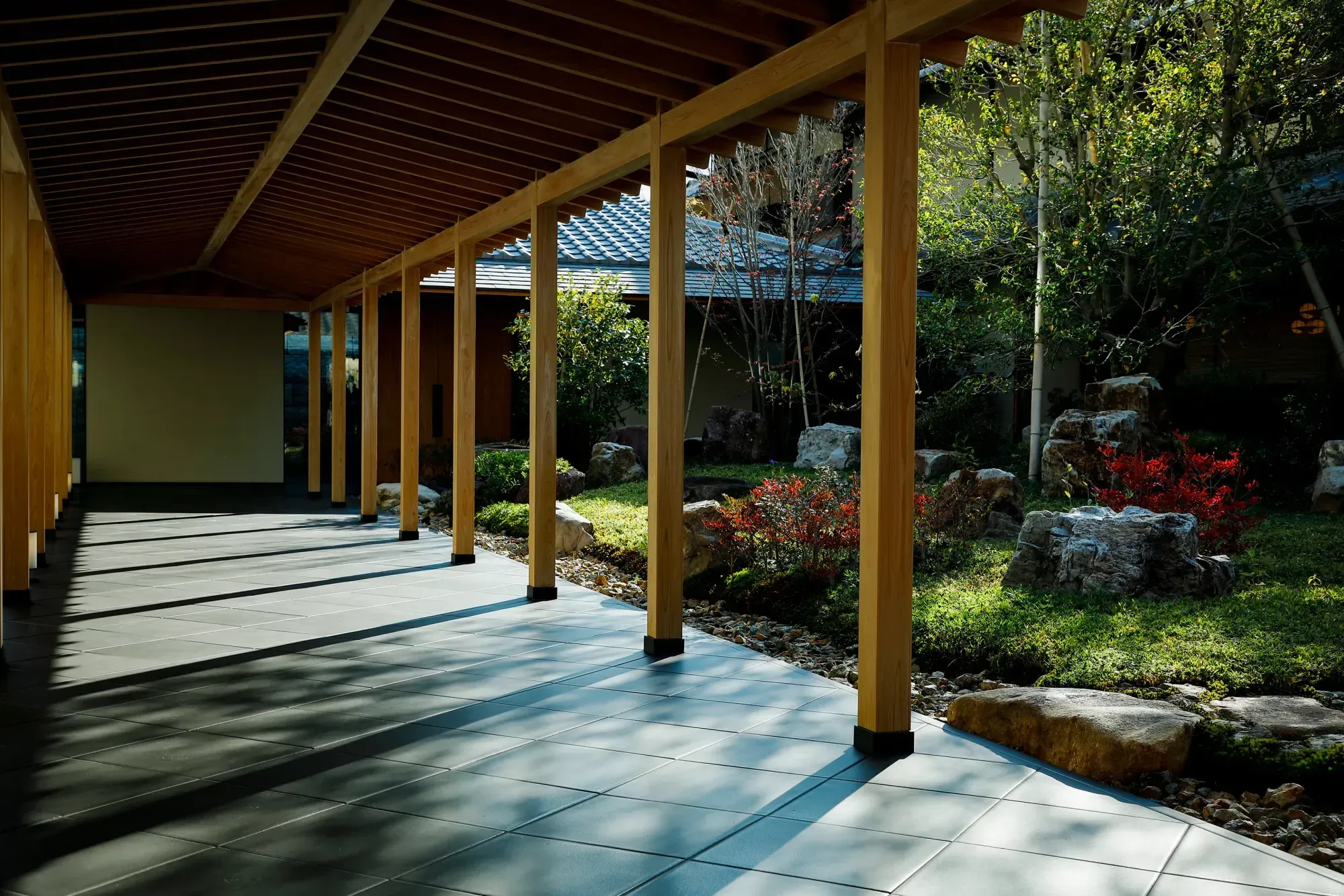
The gently curved roofs are mukuri, a form that descends from the houses of court nobles. Beams are joined without nails. The beige textured walls follow a plastering technique that dates to Jurakudai, Toyotomi Hideyoshi's Kyoto residence, and accents of kinpaku gold leaf pick up the light.
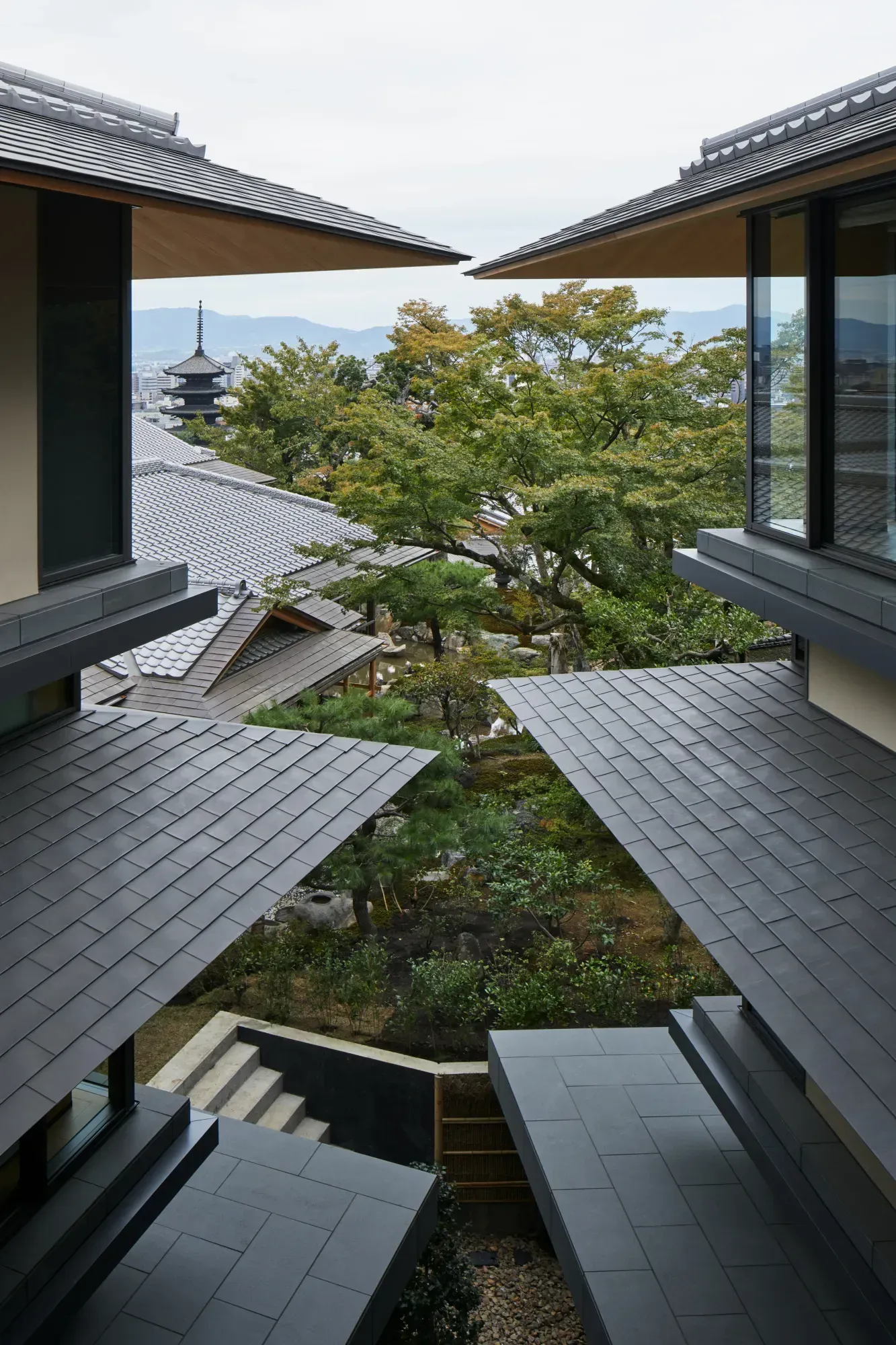
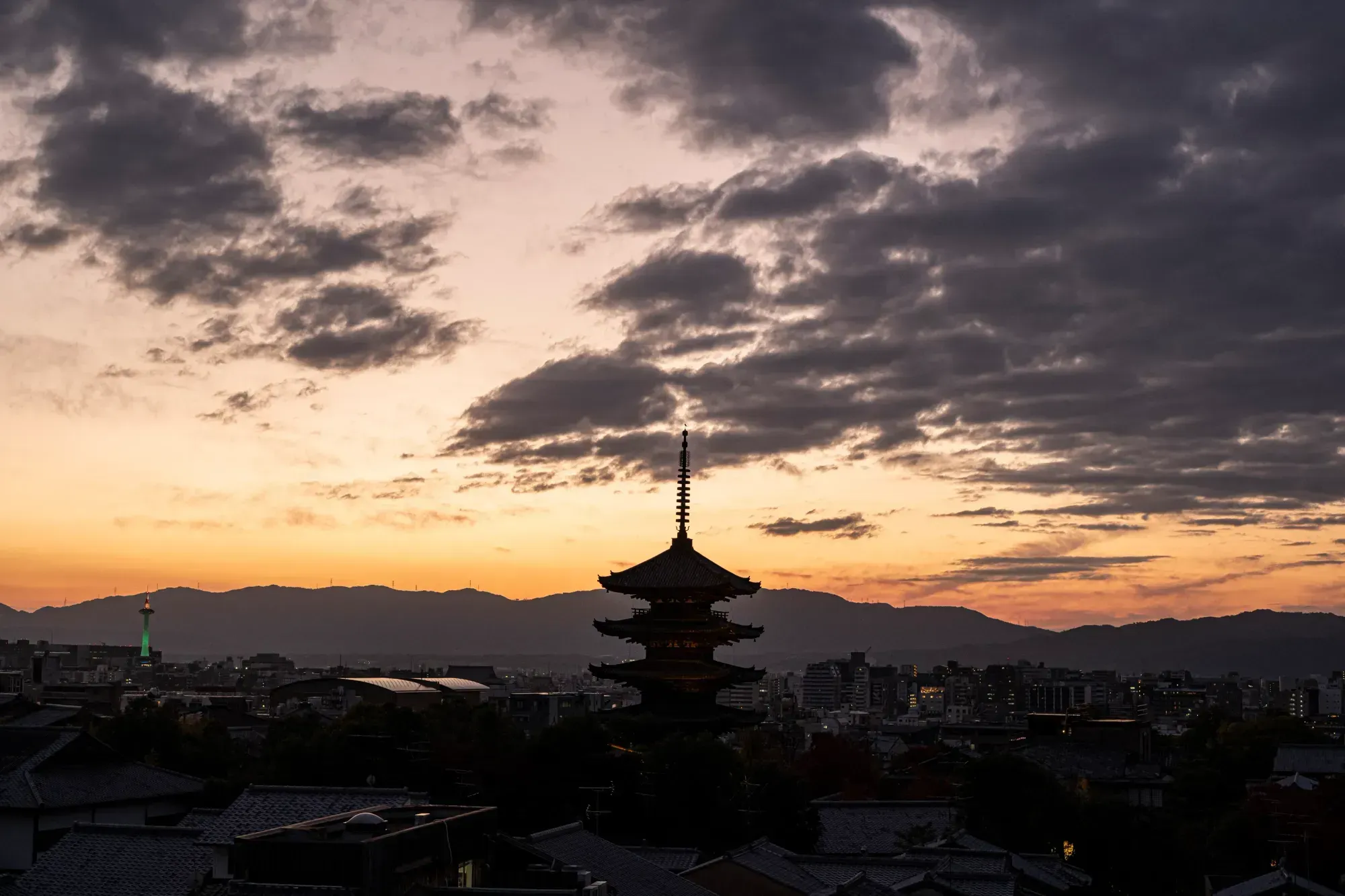
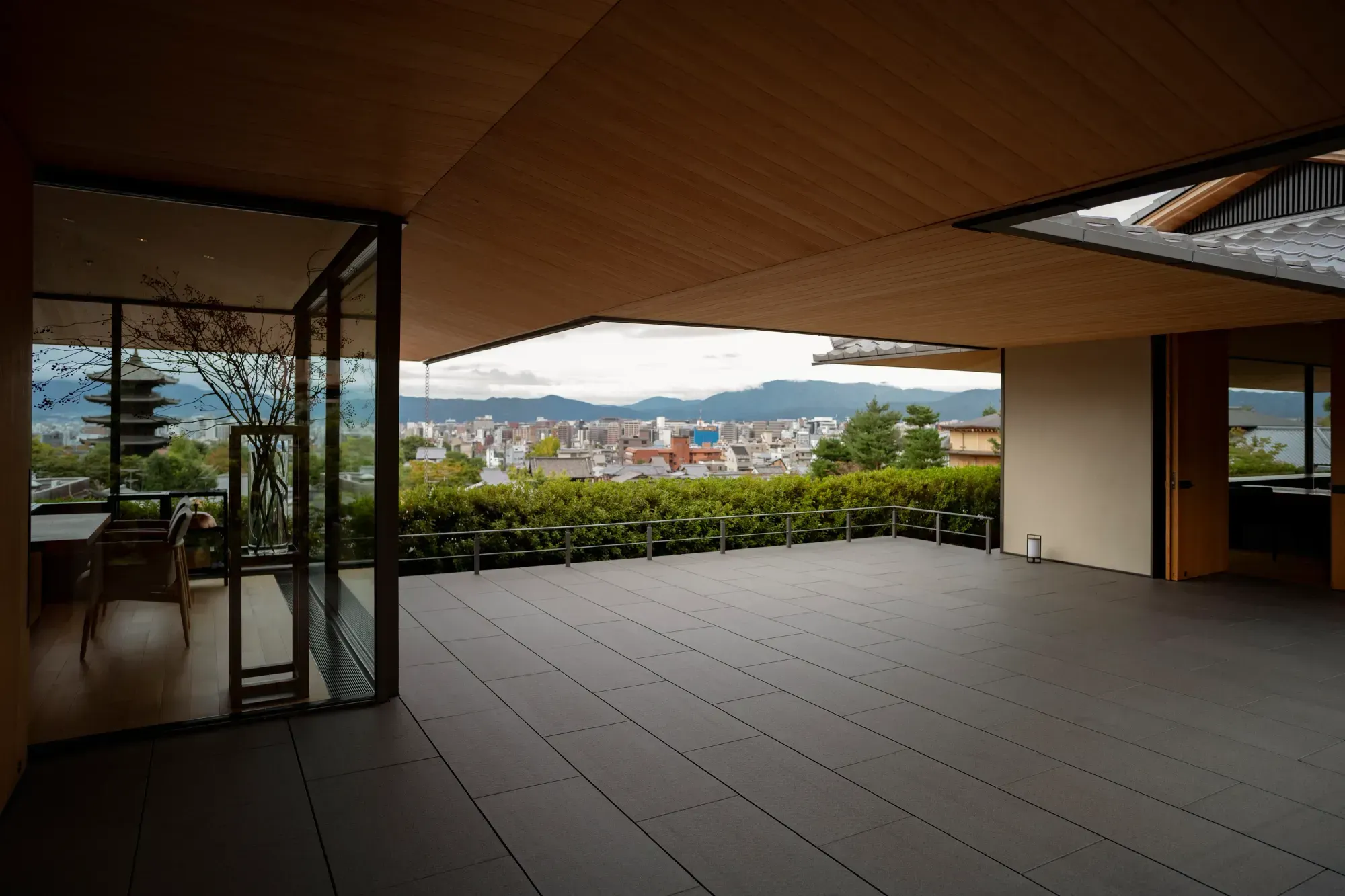
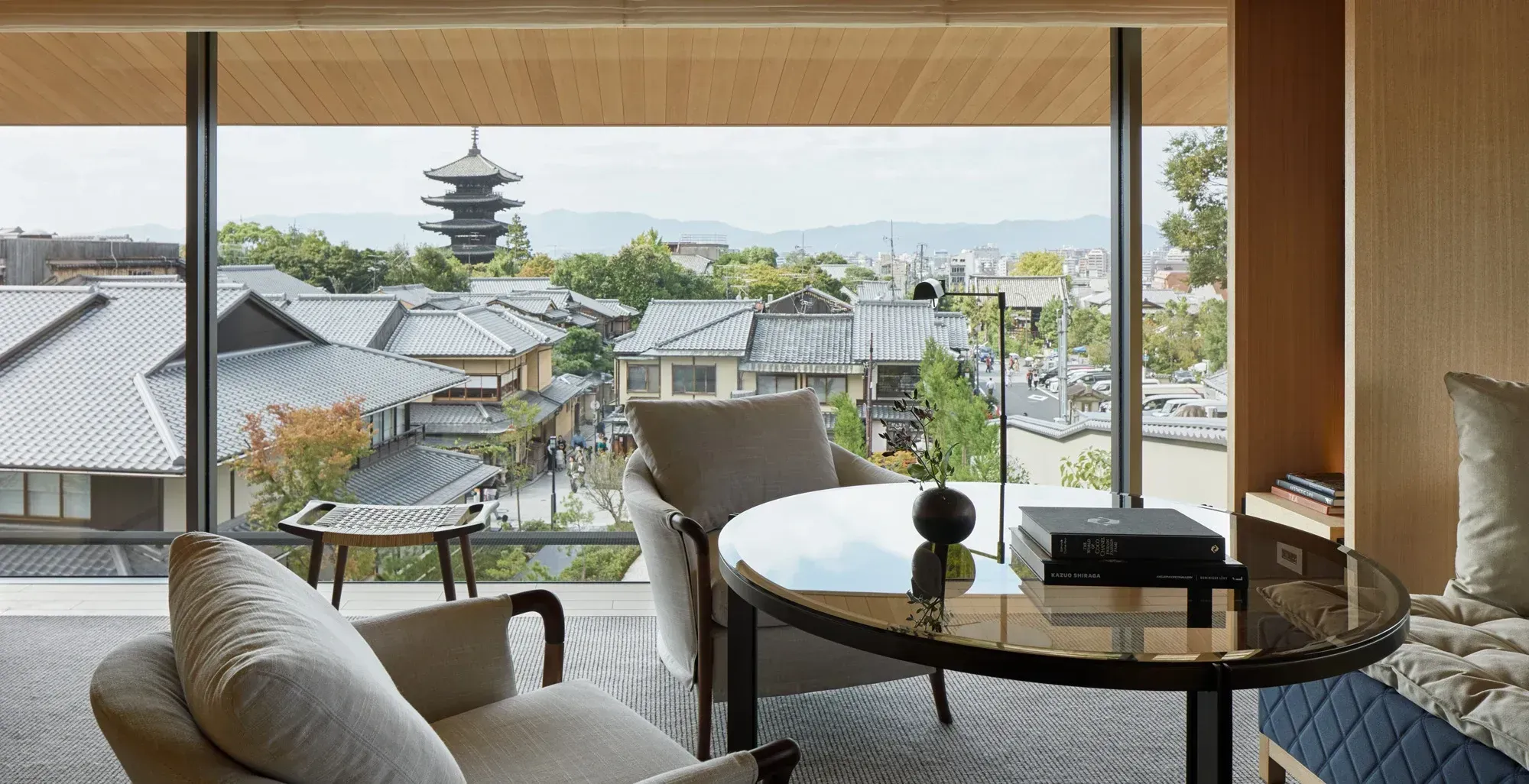
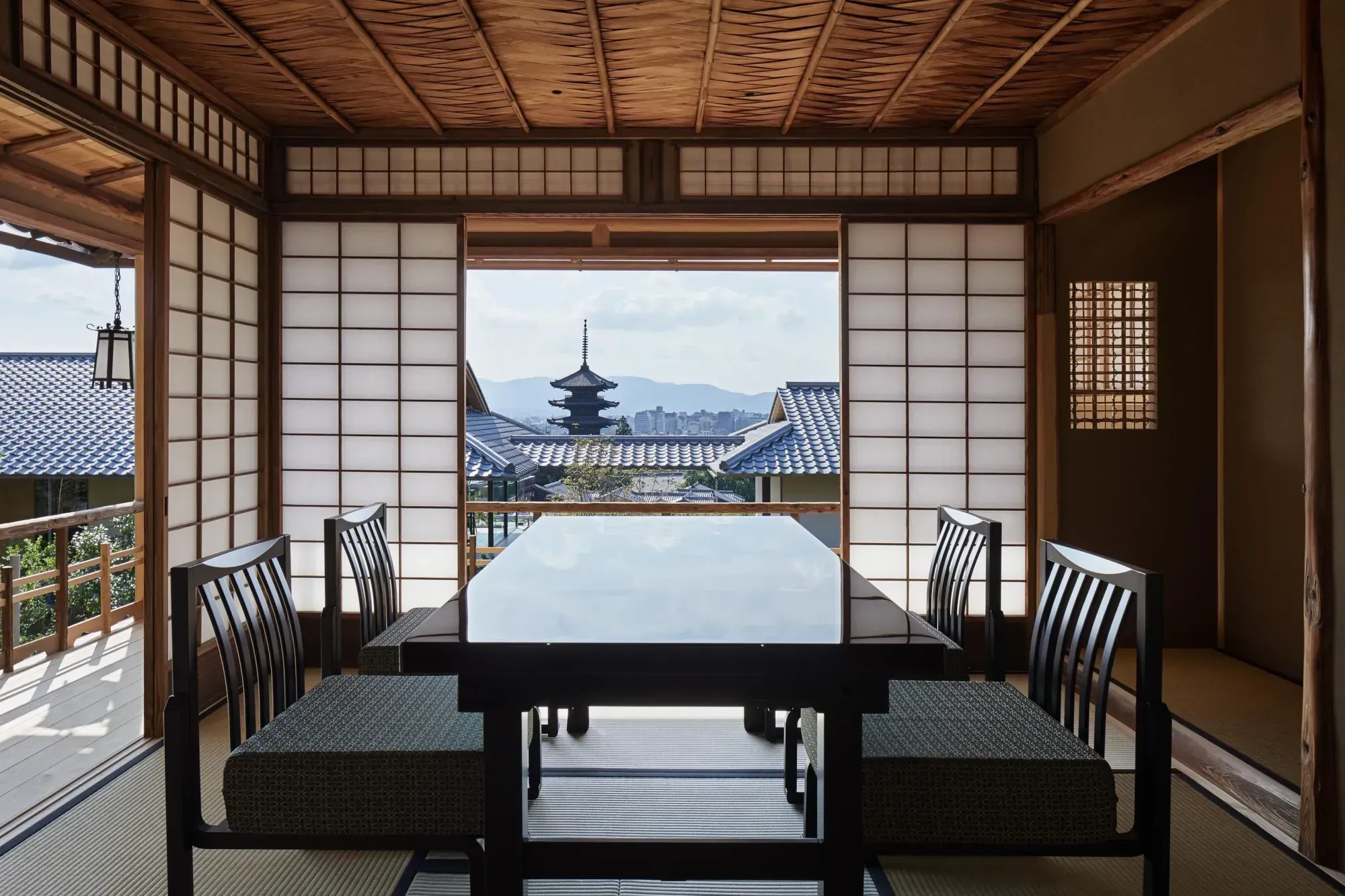
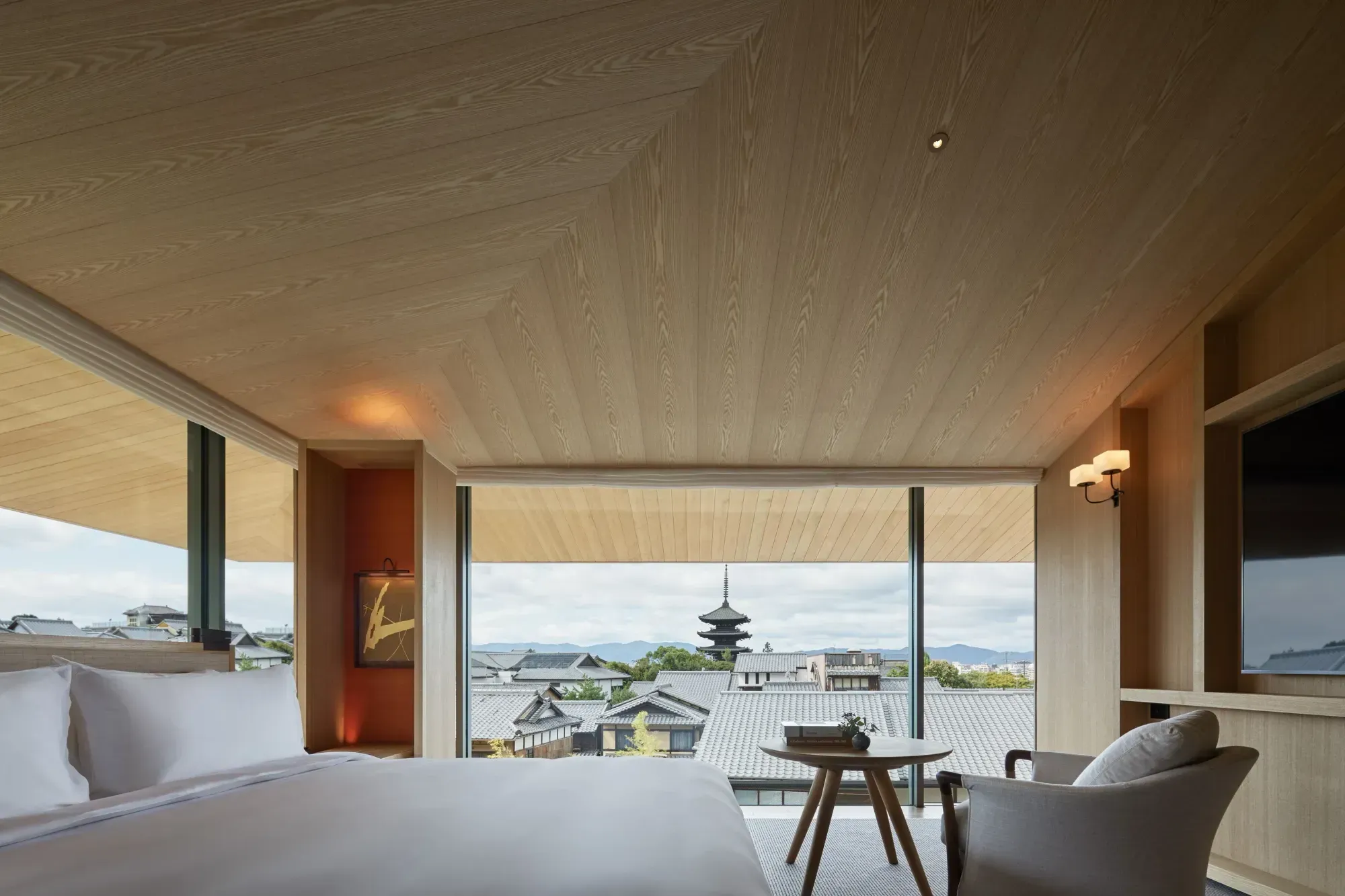
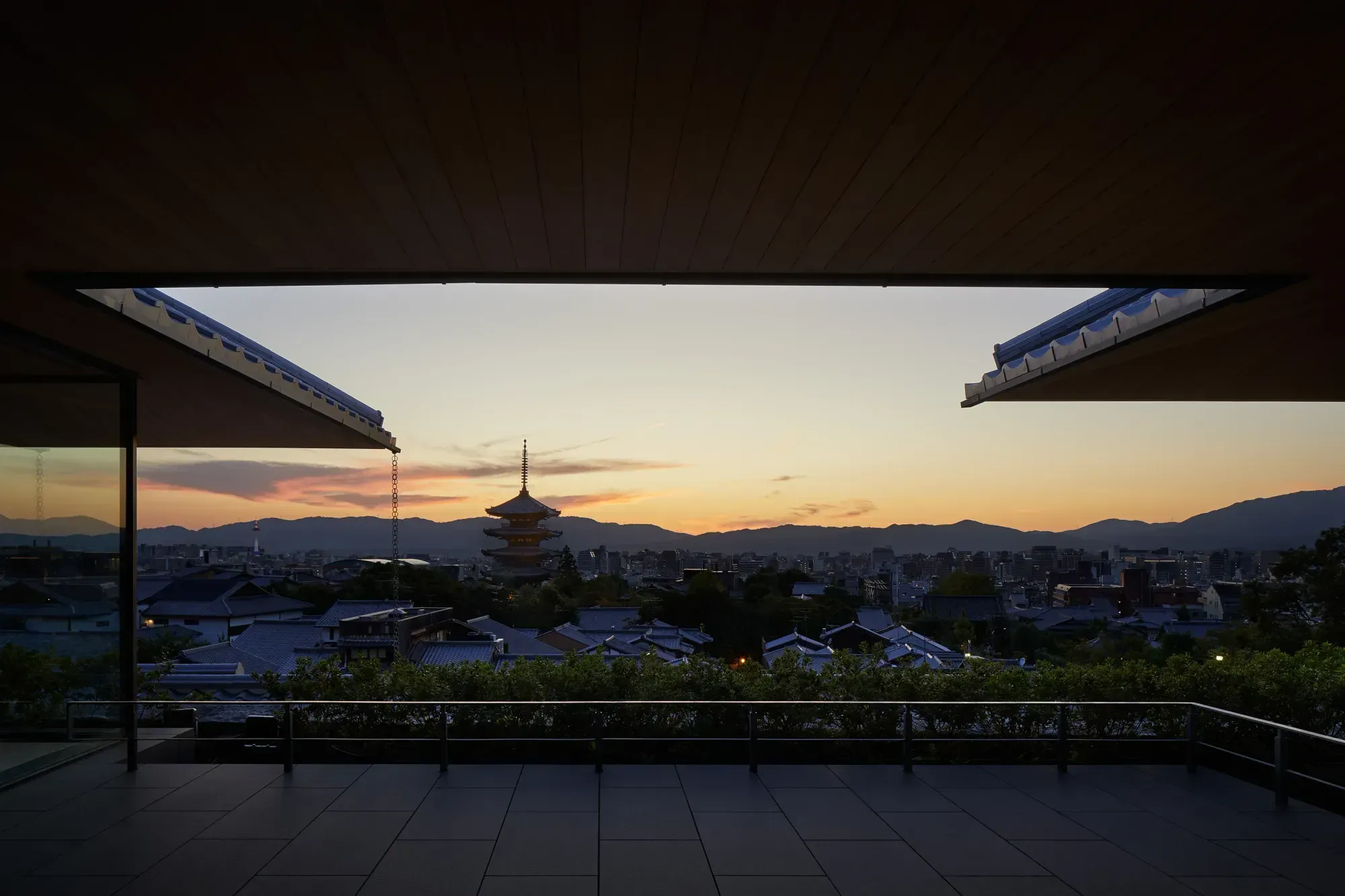
The plan is built on oku to tsugi, depth and next: a sequence of spaces that open and close as you move through them. From reception to the rooms is about 500 feet, by way of a garden-facing tea lounge and a library, and each turn brings a new courtyard, a new garden or a glimpse of Kyoyamato's roofs. The further in you walk, the higher you are and the wider the view becomes. At the top, the Yasaka Pagoda, rebuilt in 1440 under the shogun Ashikaga Yoshinori, fills the window.
Very Park Hyatt, and very Kyoto
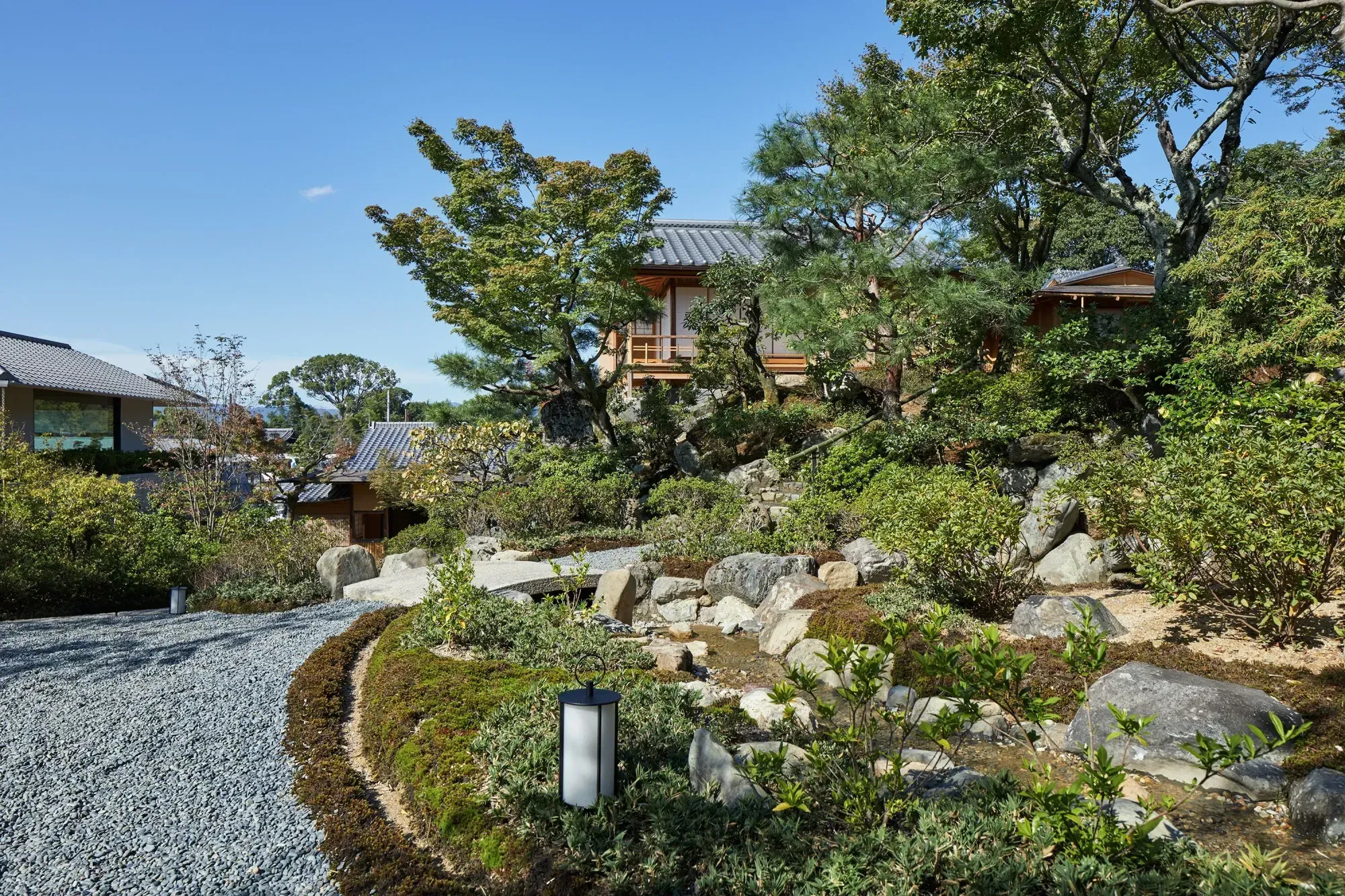
Arrival is staged the same way. The entrance garden is modeled on a lakeside cliff, with sheer rock walls and tall cedars, and the path in is kept dark and quiet so that it feels like calling at a private house rather than checking into a hotel. The lobby beyond is warmly lit and arranged like a living room, with a high-ceilinged reception and a quieter room for afternoon tea.
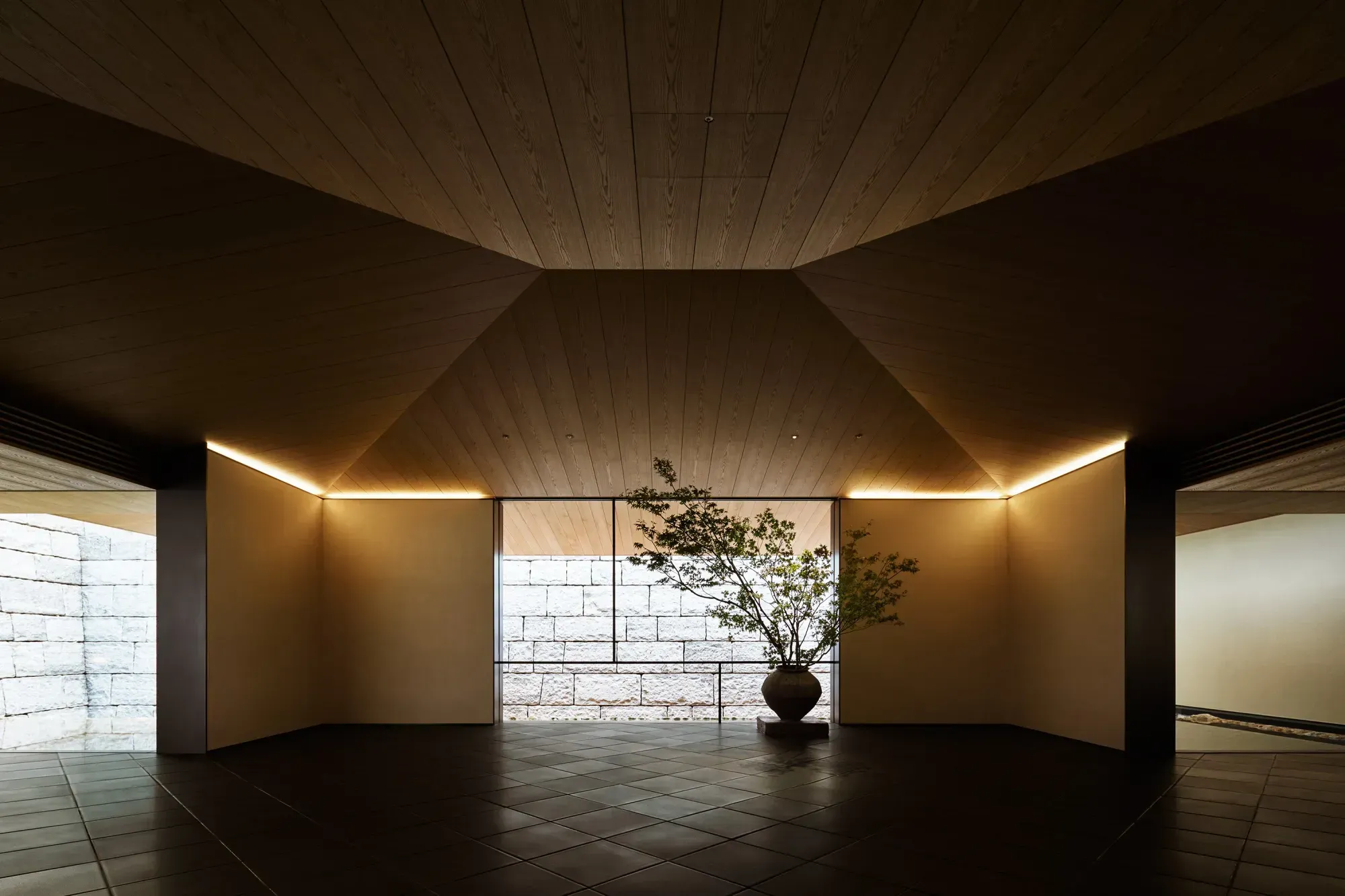
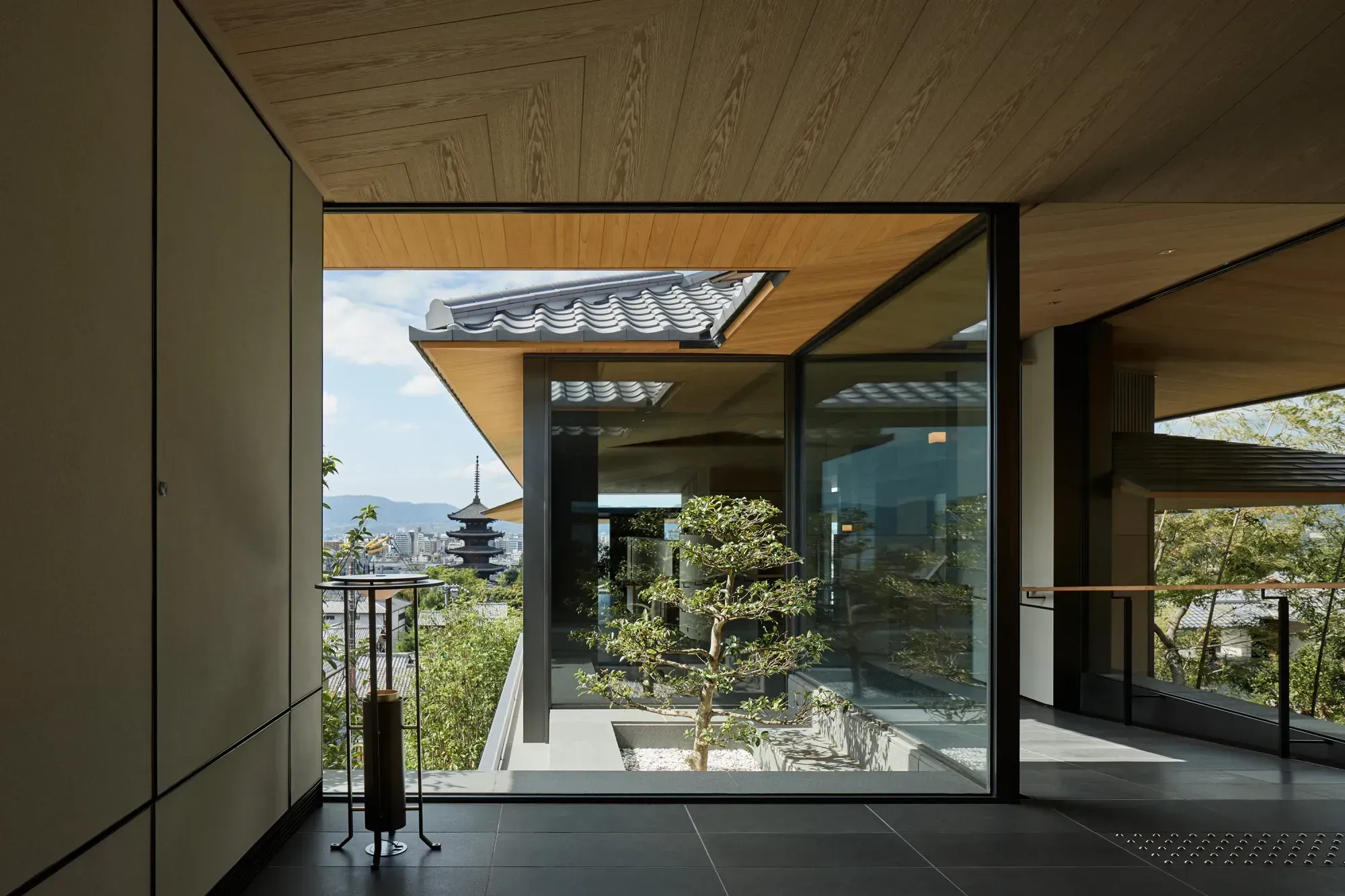
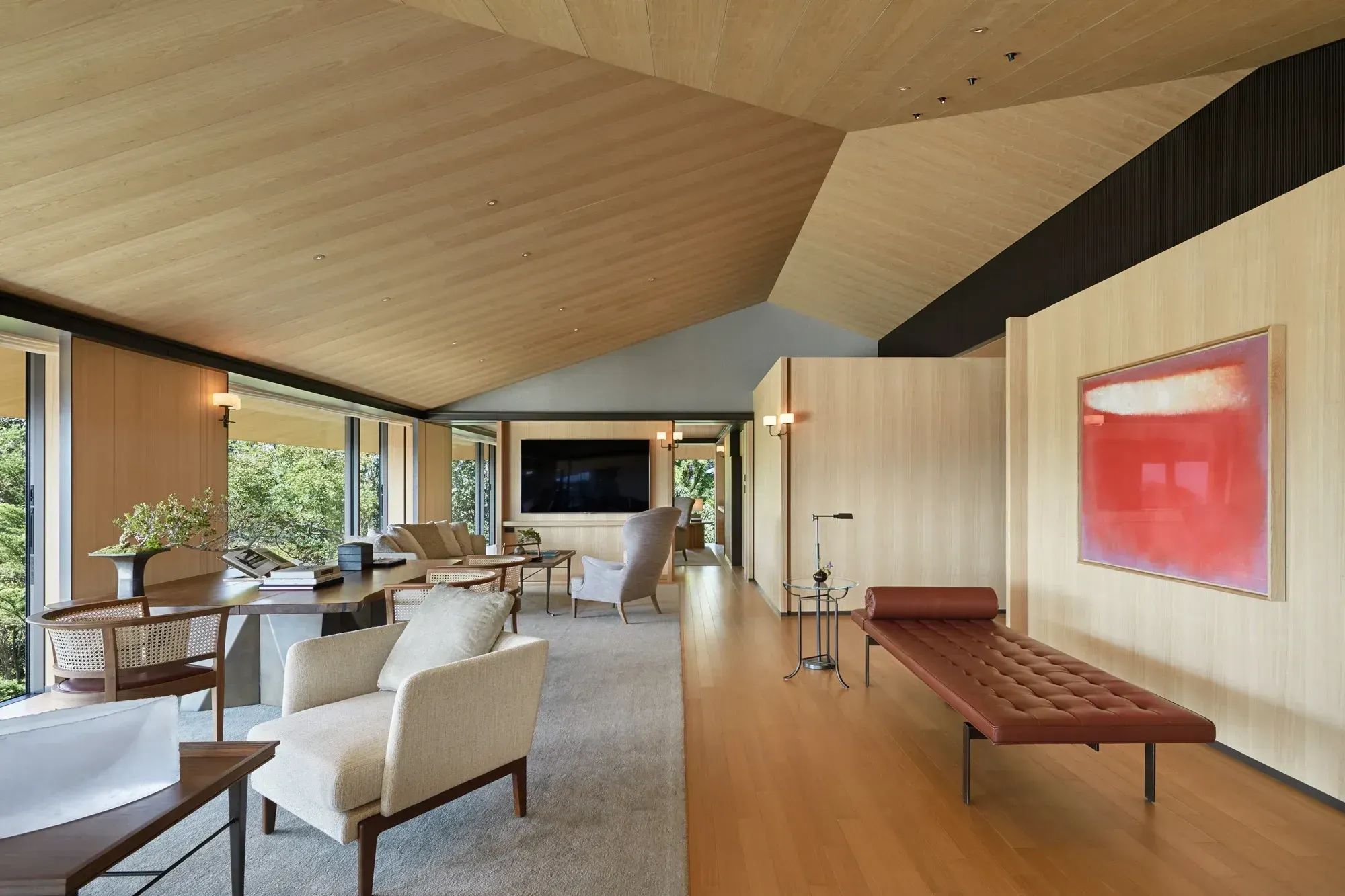
Tony Chi designed the interiors with Takenaka and conceived the hotel as a modern mountain house. Chi first made his name designing restaurants for some of the world's leading chefs. It is recognizably a Park Hyatt: natural materials, dark stone set against pale wood, low ambient light, and the view treated as part of the room. It is modern, but warm enough to settle into.
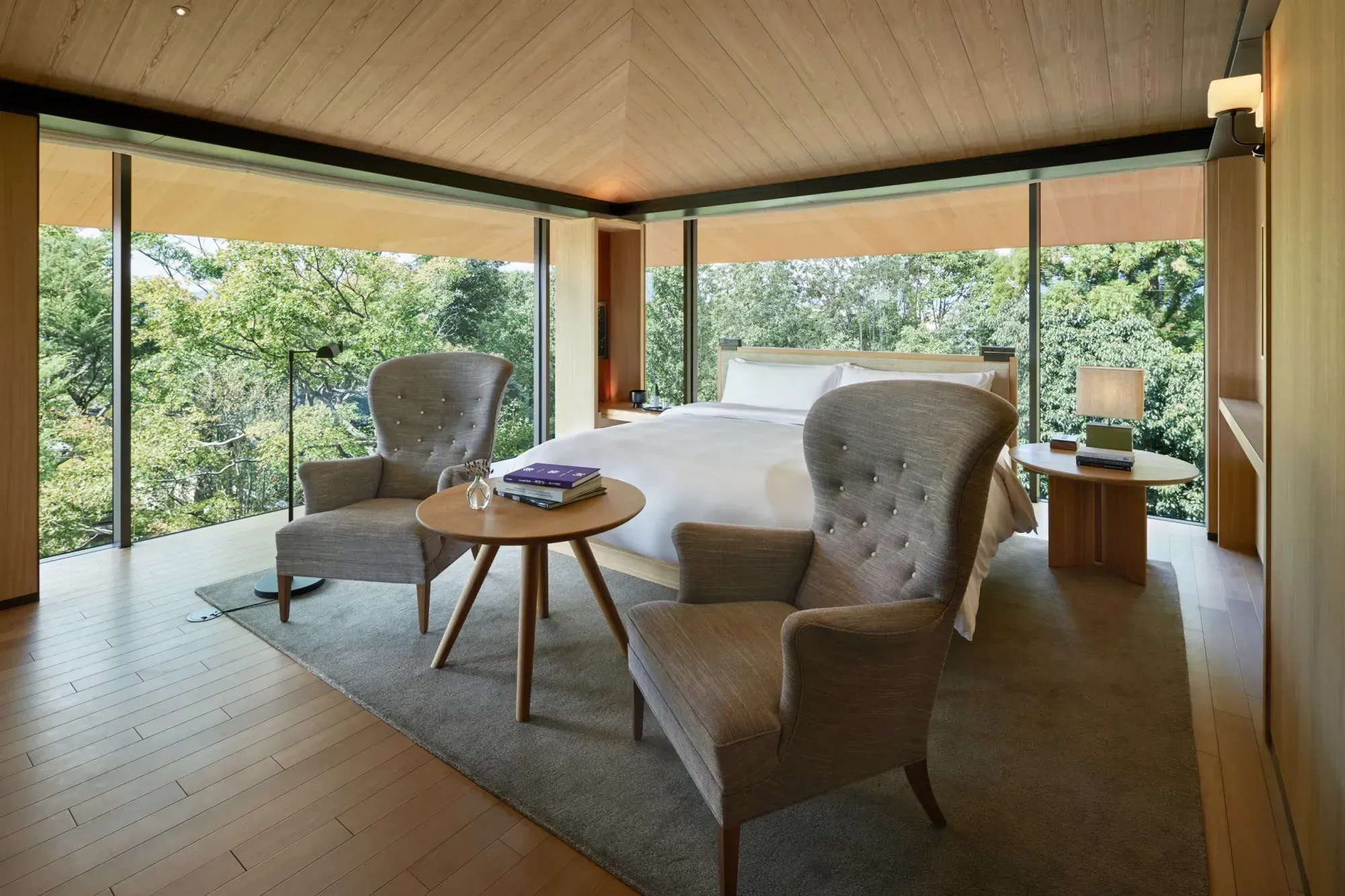
It is just as clearly Kyoto. There are wooden blinds and shoji screens, bamboo here and there, and a Japanese garden at nearly every turn. The rooms are built largely in tamo, a fragrant Japanese ash, and Japanese cypress runs through the building.
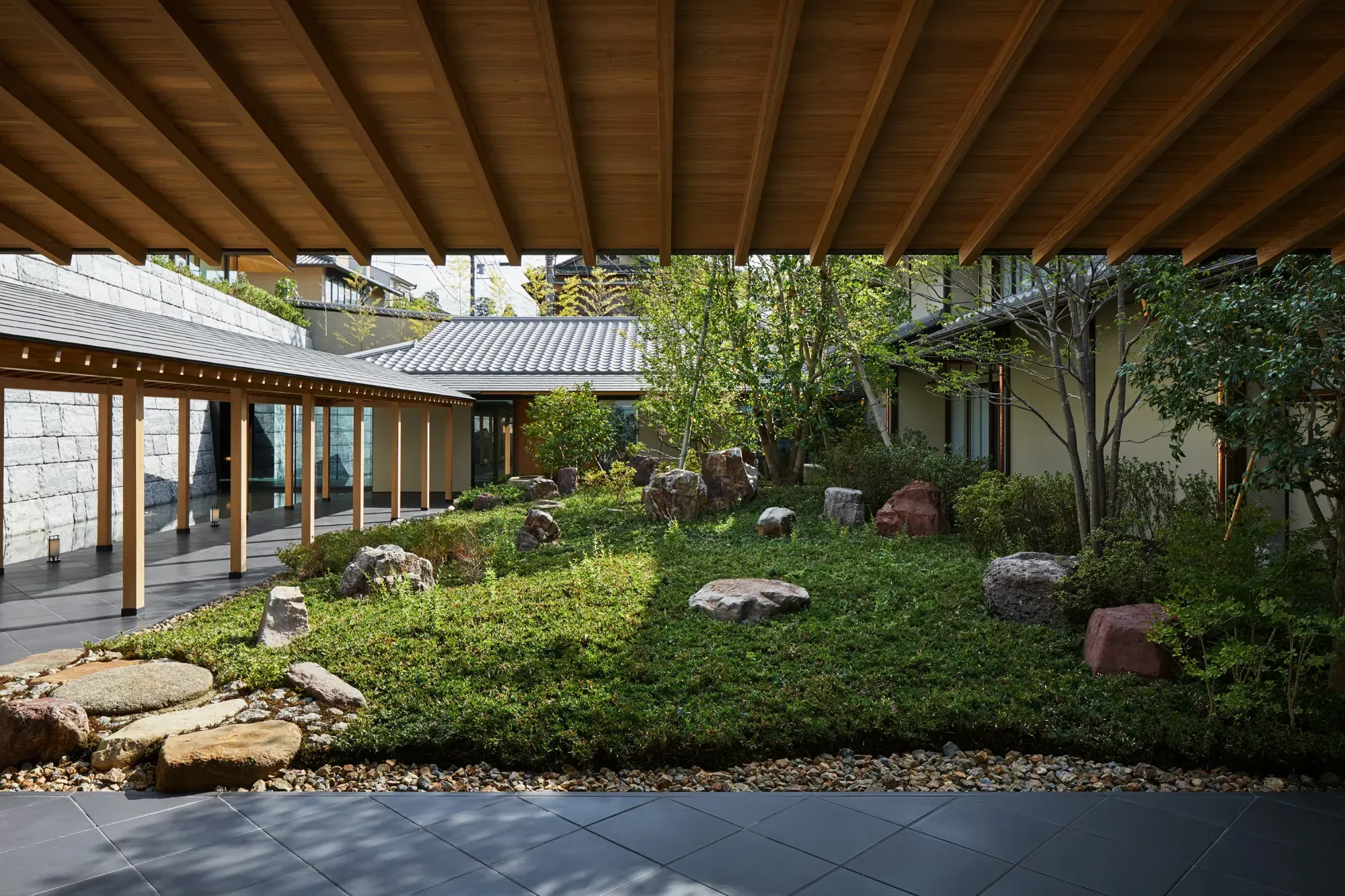
Takenaka organized the plan around teioku-ichinyo, the old idea that house and garden should be one. Layered roofs and deep eaves ease the step from inside to out, and the views are set so that a garden is almost always in sight. The hotel is laid out as a strolling garden, and its architects call it a double loop: one circuit runs through the buildings and looks out on the garden, and the other runs through the garden itself.
The quiet is engineered. Rooms have high-performance soundproof glass and doors about 10 centimeters thick. Even the room numbers and door handles are set lower than usual, so that guests passing in the corridor tend to lower their eyes.
Stones from Colorado and Hōryū-ji
The entrance garden is the work of Yasuo Kitayama, whose gardens include those at Kōdai-ji and Kennin-ji. It holds 31 stones about 300 million years old, a gift from Thomas Pritzker, whose family founded Hyatt. Kitayama went to Colorado to choose each one himself, and the hotel calls it the Pritzker Garden. Set among them are foundation stones from Hōryū-ji that once stood in Kyoyamato's garden. The planting is meant to evoke satoyama, the cultivated slopes at the edge of a mountain village, and the garden changes with the angle you see it from and with the season. Its Japanese name, Eishin-tei, refers to cultivating wisdom.
Breakfast from the ryotei next door
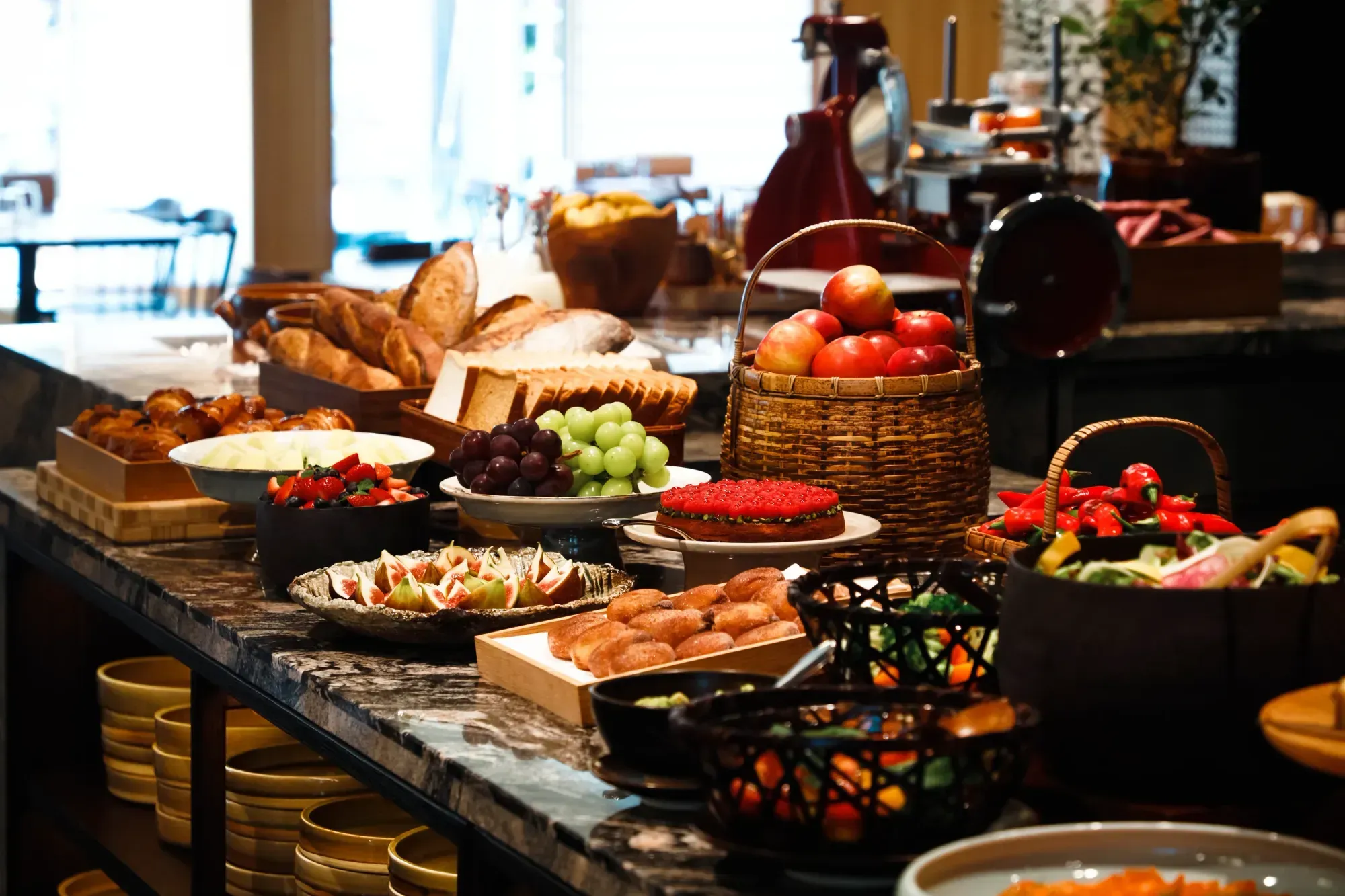
Breakfast is served at KYOTO BISTRO, which opens onto Ninenzaka: an open kitchen, greenery and a warm room. From the tables you can watch the street wake up as the morning light comes in, early walkers on the stone slope and people cycling past. Before the main dish arrives there is a small buffet of bites, pastries, fresh fruit and freshly squeezed juice.
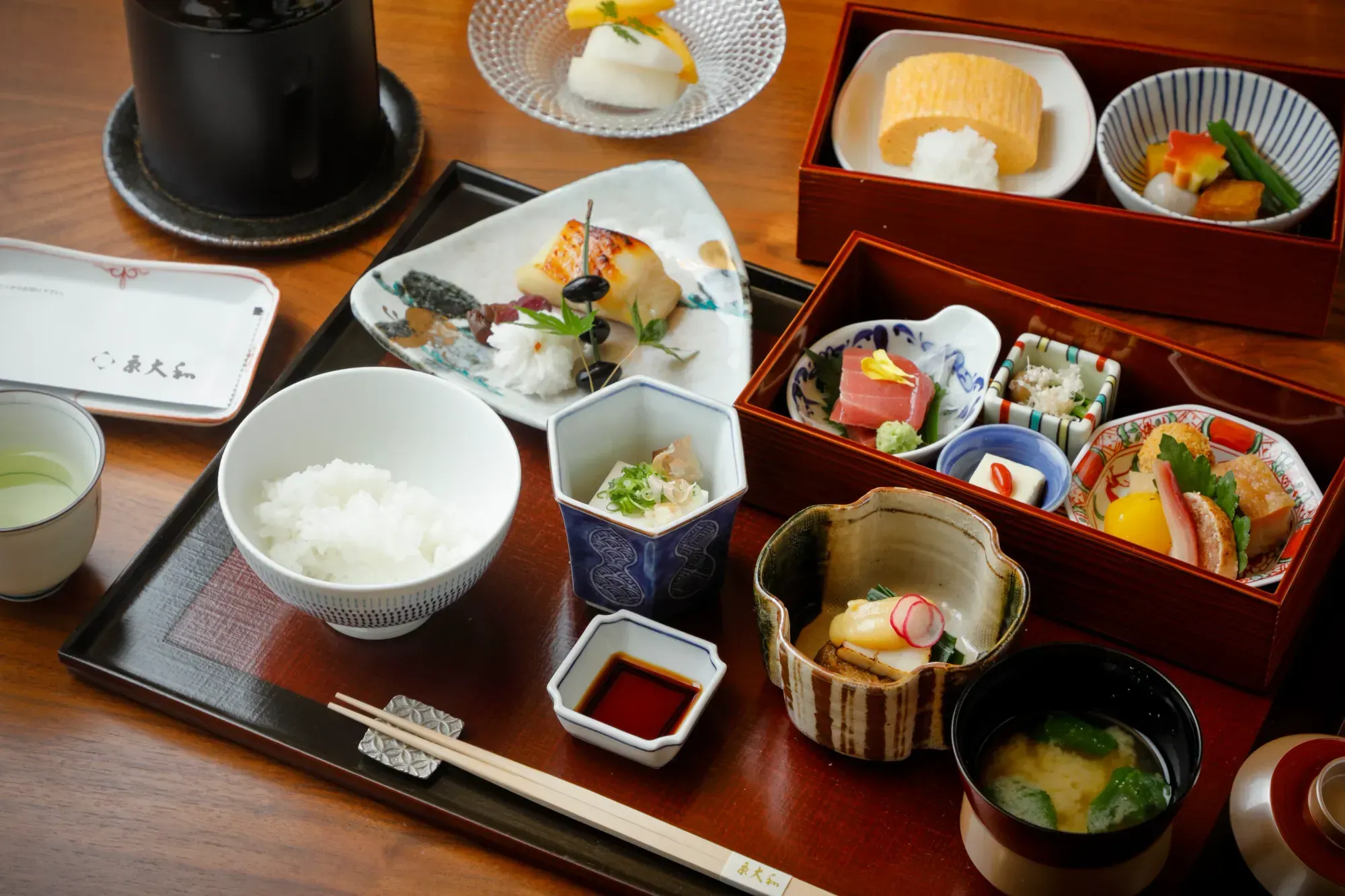
The Japanese breakfast is the one to order. It costs extra and is made in limited numbers each morning, so book it ahead. It is worth both, because it is prepared by Kyoyamato. On the first morning, the Akatsuki menu brought rolled omelet, Saikyo miso black cod and shijimi clam miso soup. The next morning, our Shinonome menu opened with an onsen egg in dashi and beef sukiyaki with burdock root and mitsuba, followed by grilled sea bream with yuzu pepper and white miso soup. The rice is Kyoto Koshihikari, cooked in a small pot for one, and it comes to the table glossy and pleasantly chewy. It is an occasion more than a meal, and the sukiyaki was the dish we would order again.
On the Western side, order the French toast: crisp outside, soft inside, topped with caramelized banana. It is technically the Western option, but the care in it is Japanese.
Teppanyaki, facing the pagoda
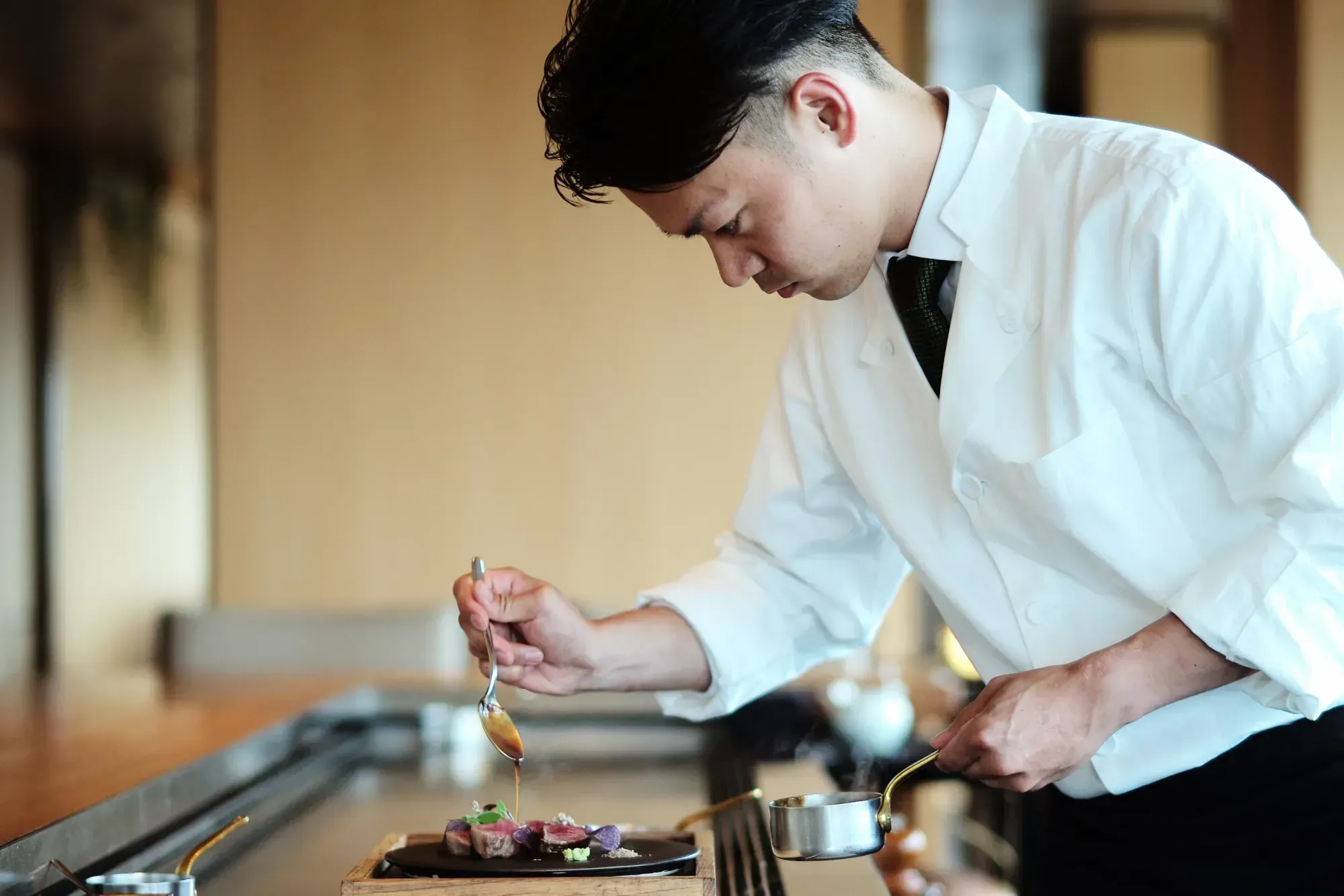
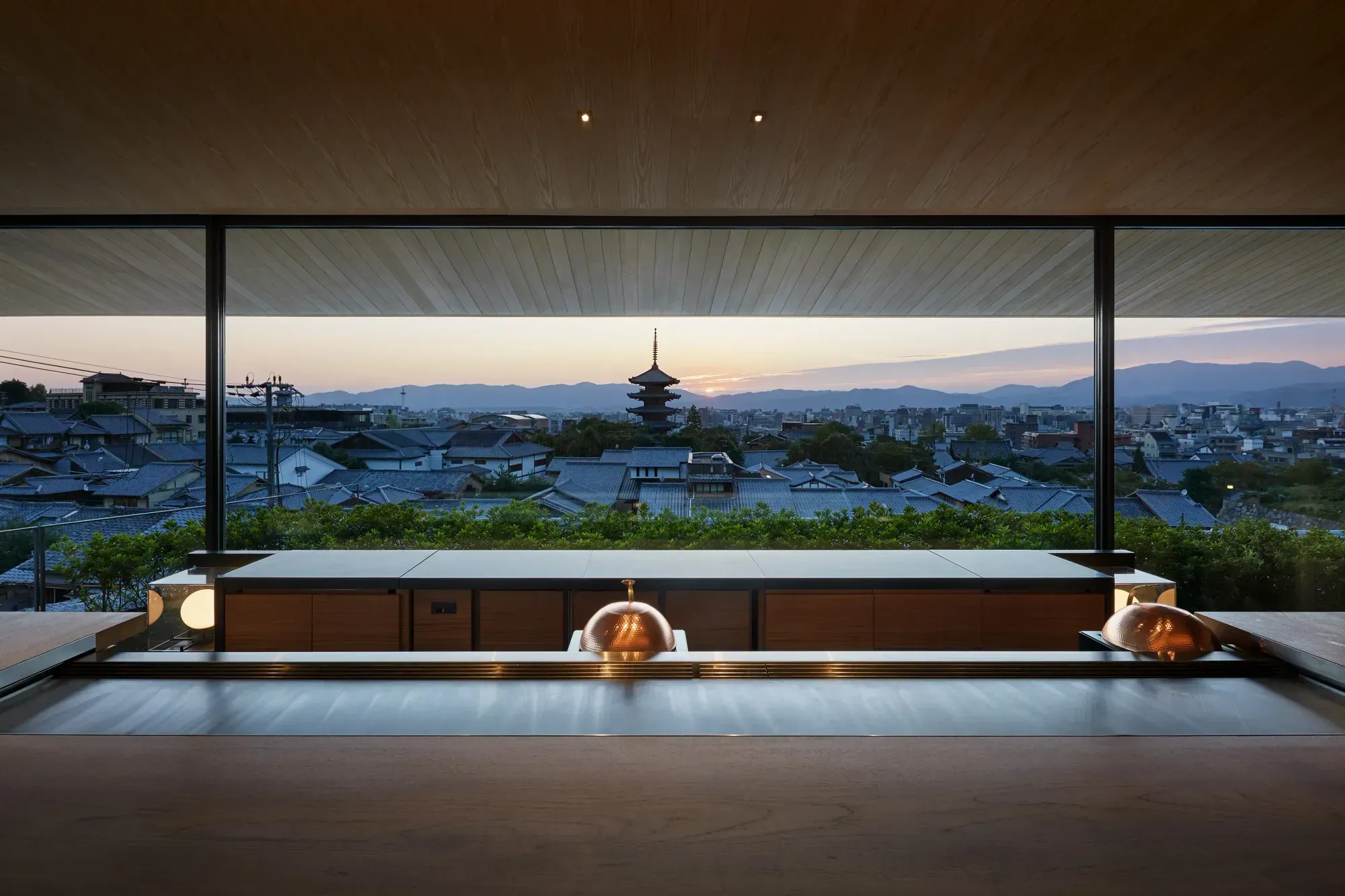
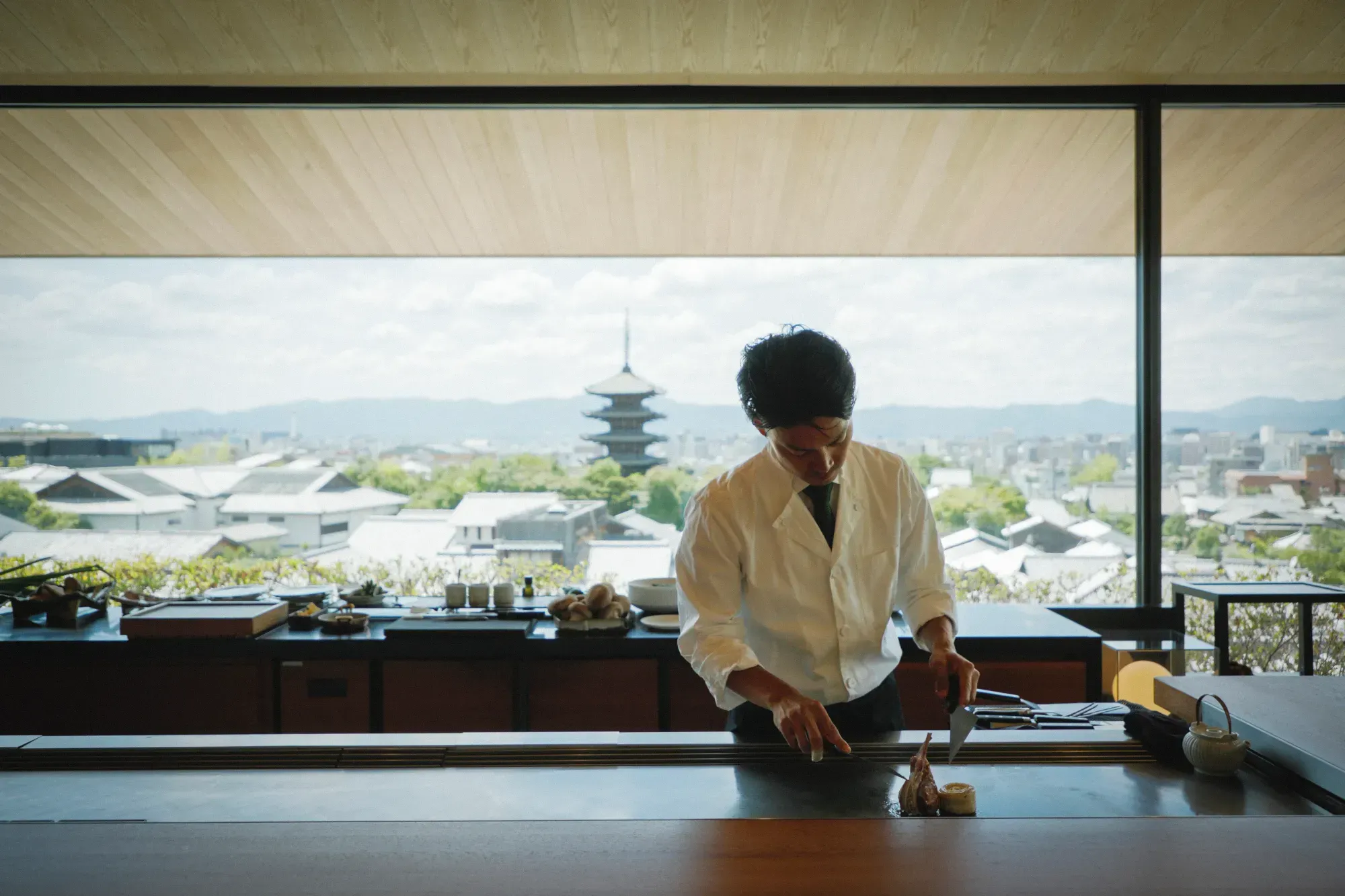
Yasaka, the signature restaurant on the fourth floor, opened with the hotel in October 2019. It cooks teppanyaki with French technique on an open kitchen stage, at a counter that looks straight out to the pagoda it is named for. There are two dinner seatings.
The chef de cuisine since July 2023 is Kentaro Koyama, born in Kumamoto in 1989. He spent five years cooking in France, including at SaQuaNa in Honfleur under Alexandre Bourdas and at Maison Lameloise in Burgundy under Eric Pras, then ran the kitchen at French Monstar in Tokyo. Koyama sees the pairing of French refinement with teppanyaki, where everything is cooked from scratch in front of the guest, as a chance to make something new rather than a compromise between the two. The parting advice he took from Bourdas was to stop imitating others and cook his own food.
We ate at the 8pm seating. The autumn menu began with Kristal caviar over sesame tofu with red Manganji pepper and Japanese chestnut. A consommé of fish from Ine on the Kyoto coast, with Naruto kintoki sweet potato and autumn truffle, came next, then Nanatani duck from Kameoka with fig and buckwheat, and grouper with black edamame and clams. The beef course offered Japanese wagyu tenderloin or Ohmi beef, and the meal closed with Kyotango Koshihikari rice with matsutake and a pear crêpe Suzette.
The wine pairing ran from Krug Grande Cuvée to a 2023 Pinot Noir from Tamba Wine, a winery in Kyoto's Tamba region that planted Pinot Noir vines brought from Germany in 1988.
After dark
Next door to Yasaka, across a small patio, is Kohaku, the hotel's bar. Its name means amber, for the color the sky over Kyoto turns at dusk, and that is the hour to go: the seats line a walnut counter facing the pagoda and the old roofs of Higashiyama, and after dark the pagoda is lit.
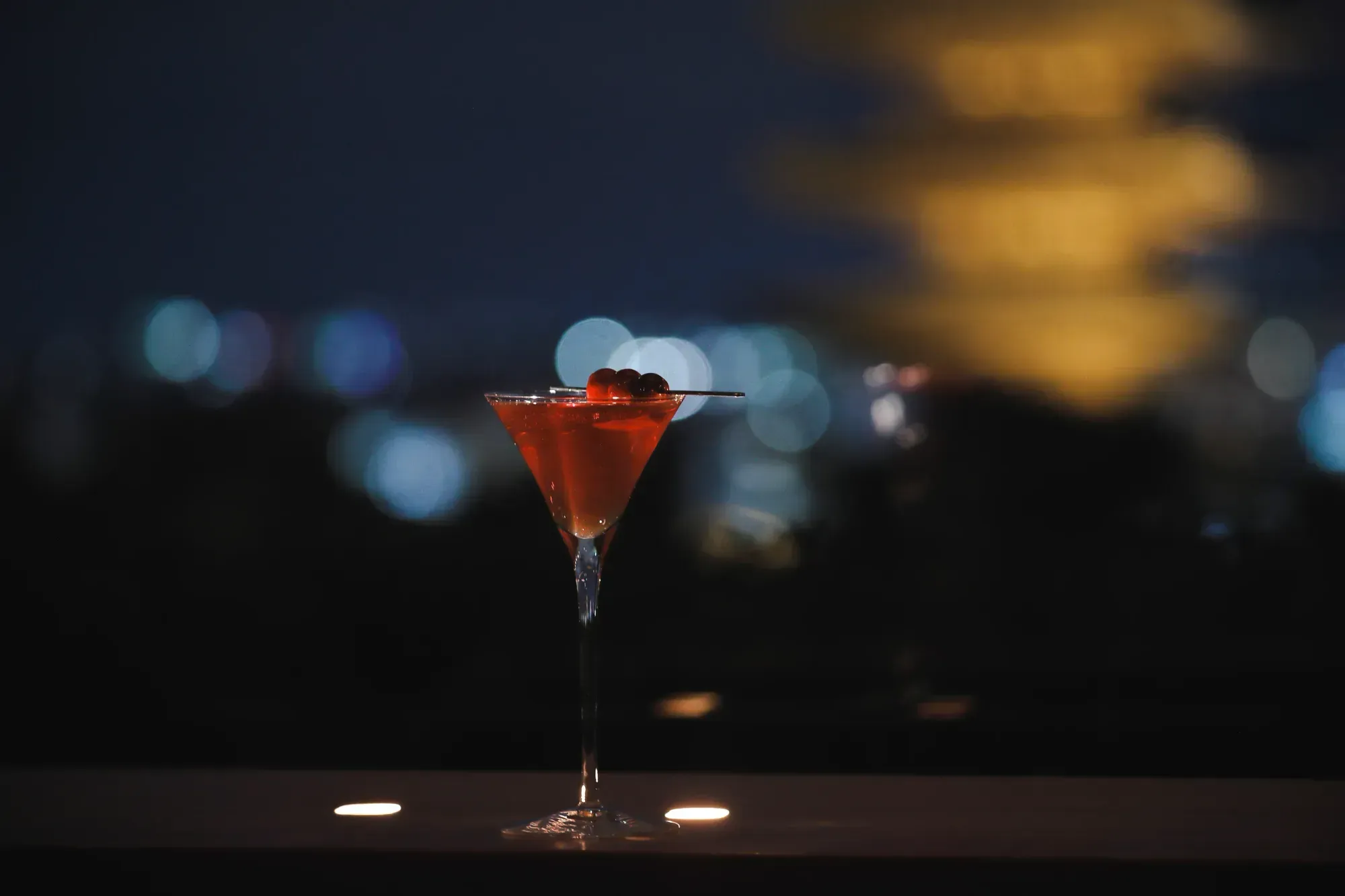
Hironori Otsuka, who leads the bar, builds the menu around four sides of the city: its history, its art, its ingredients and its culture. The house gin and tonic is made with Ki No Bi Seiryu, a gin developed with Kyoto Distillery for the bar, and the signature, The Last Samurai, takes its cue from Soyotei, a Kyoyamato tea room that the hotel says once hosted samurai who left their mark on history. Since February 2026 the bar has also brought in guest bartenders from across Japan under the name Bar Craft in Kyoto.
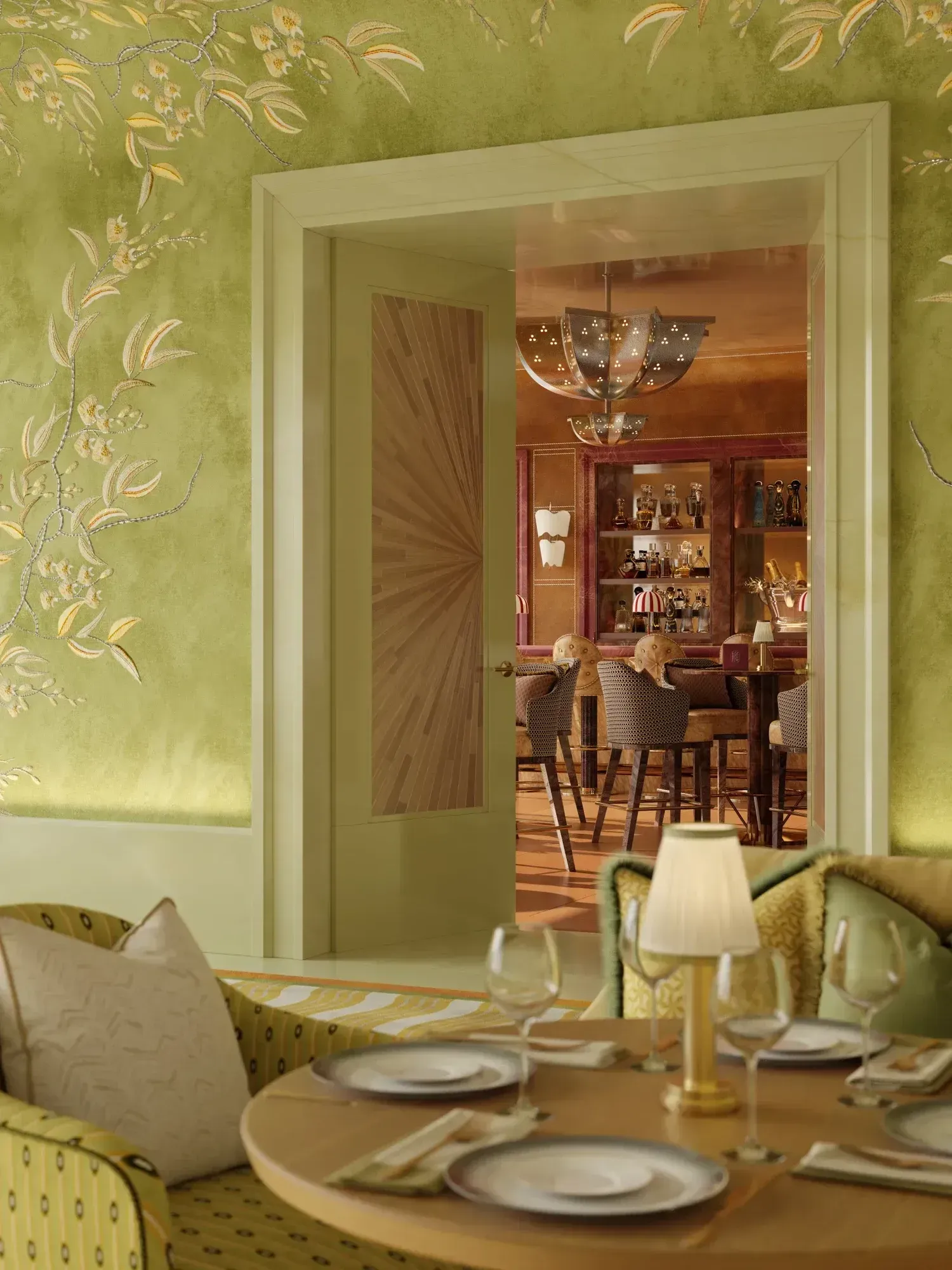
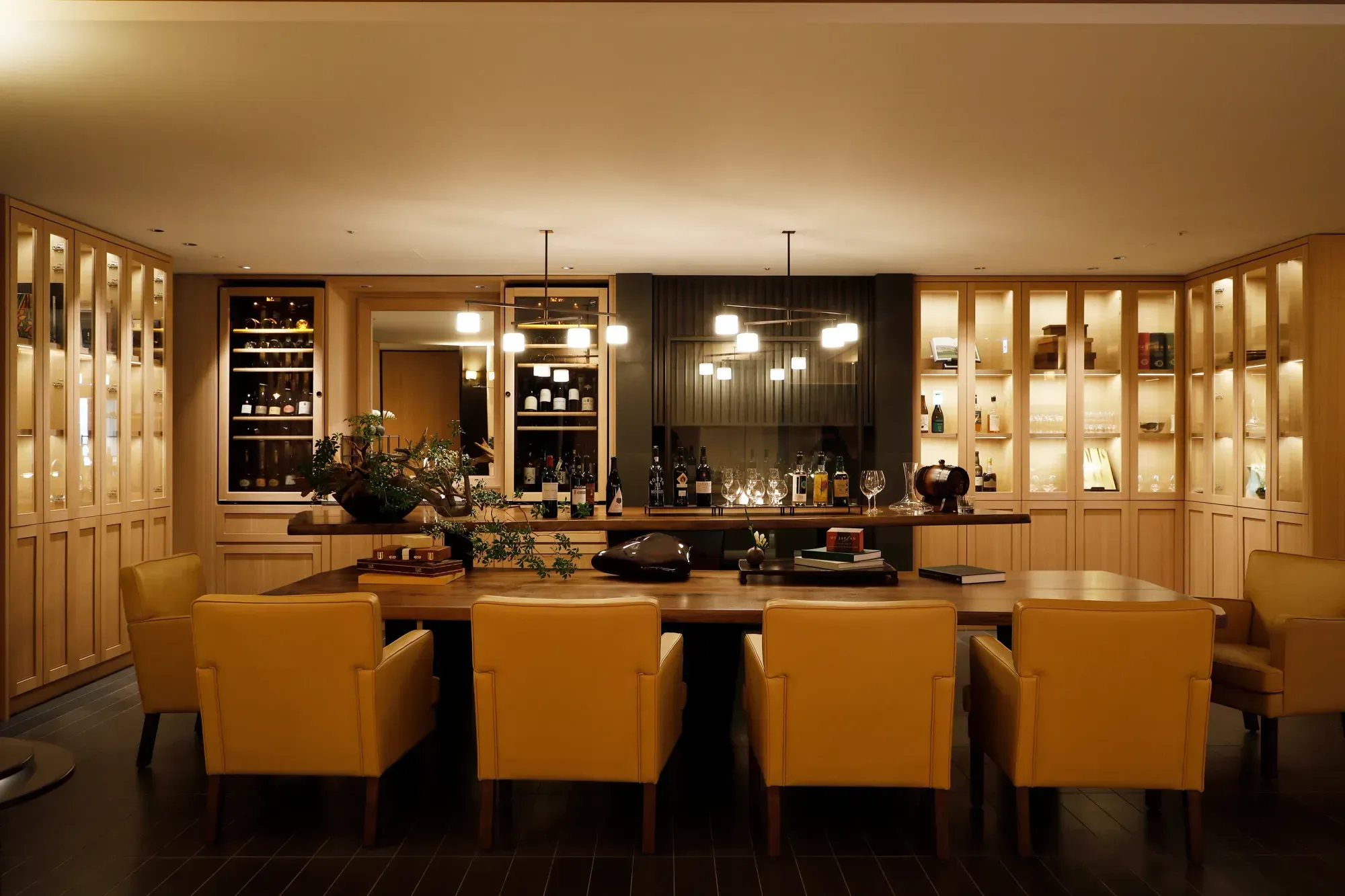
Downstairs, The Living Room, the center of the house with its fireplaces and counter tables, turns into a wine and sake bar from 5pm to 9pm. The list leans French, and the cheese comes from the affineur Hervé Mons, a Meilleur Ouvrier de France, set against three wines or three sakes.
A spa without a fingerprint
The spa is small but cozy. It has a treatment suite for two with its own private bathhouse, dry and mist saunas, and treatments by Kotoshina, an organic skincare brand from Uji whose signature oil is pressed from tea seeds. The fitness center is modeled on a dojo. What stayed with us was the condition of it all. The spa and the locker room were kept so perfectly that we could not find a single fingerprint or a drop of water.
Eight teas and an origami box
The service works the same way. While we worked in the lounge, staff brought over eight different teas to choose from. At turndown they left a small origami box on the nightstand for jewelry. In the room were wagashi from Oimatsu, a confectioner founded in 1908 in the Kamishichiken geisha district, including a whisky yōkan made with the hotel. Beside them sat a chocolate Yasaka Pagoda in a garden of black sesame chocolate stones and Uji matcha moss.
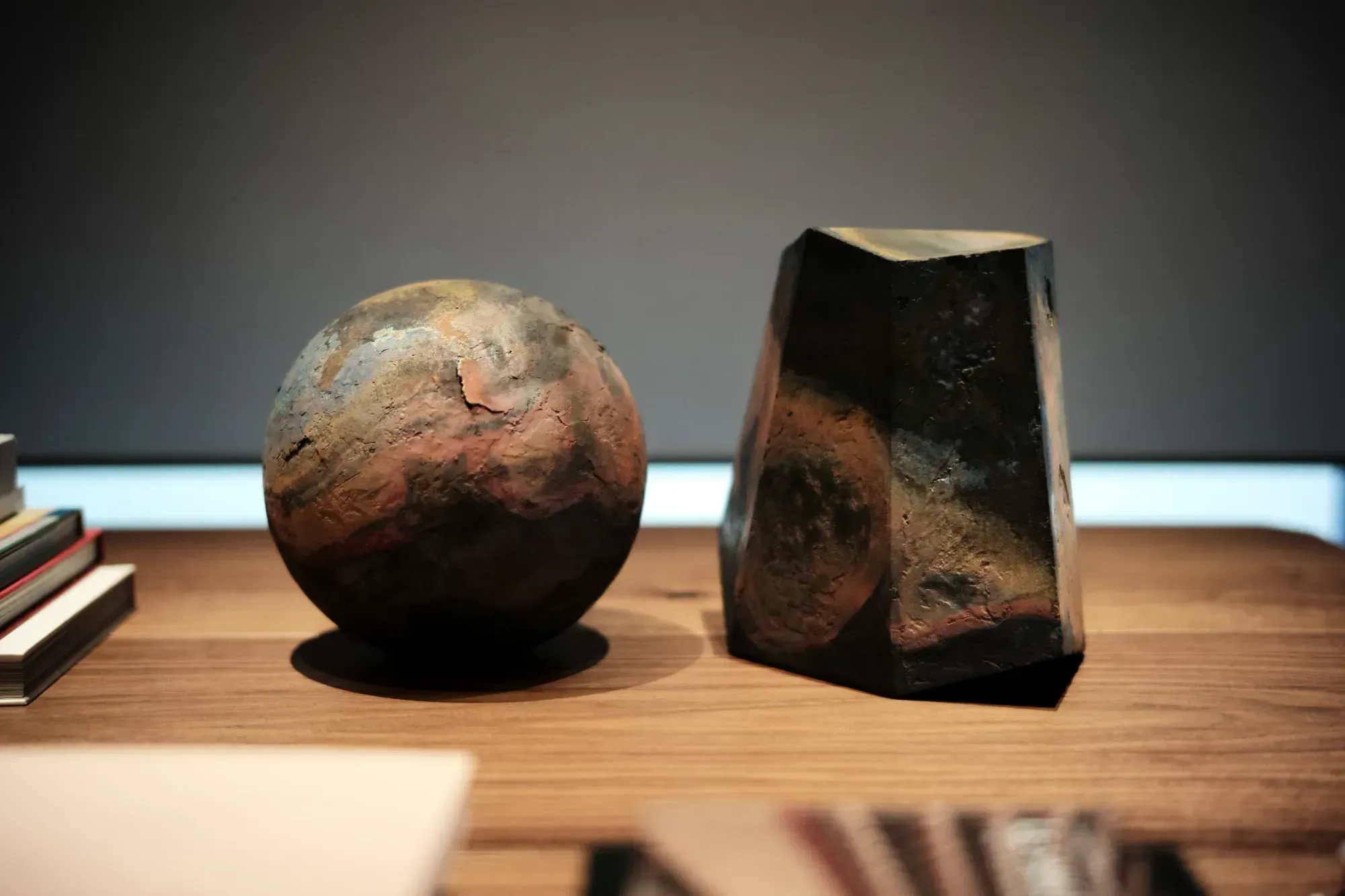
The art follows the same restraint. Katsutomi Horiki's abstract oil paintings hang in the signature suite, and works by the ink painter Toko Shinoda and the sculptor Fabrizio Corneli are placed throughout, in a collection that runs to sumi ink paintings, indigo dyes, carving in wood and stone, and sculpture in bronze and glass.
None of these things is large. The hotel is made of them, which is why the street outside can be loud and the house still quiet.
Getting there
Park Hyatt Kyoto is at 360 Kōdaiji Masuya-chō, Higashiyama-ku, Kyoto 605-0826, about 15 minutes by taxi from Kyoto Station. Reserve the Japanese breakfast by Kyoyamato when you book the room, and ask for Yasaka's later seating for the pagoda after dark. Kohaku is open from 4pm to midnight, and hotel guests do not pay its cover charge.
The pagoda in the window
Most of what is good here follows from the 10-meter rule. It keeps the hotel low beneath the pagoda, and the house is arranged around that view: the counter at Yasaka faces it, Kohaku's windows hold it, and the long walk up from reception ends with it filling the glass.
Kyoyamato sets the other measure. It has been on this hillside since 1949, its kitchen cooks the breakfast worth waking for, and its tea rooms were lifted whole rather than taken apart to make room for the hotel. Outside the gate, Ninenzaka fills by mid-morning. Inside, the house stays quiet, and in two nights we did not find a seam in it.
Exqz was hosted by Park Hyatt Kyoto.